The Balearic Islands have considered a total ban on burkas and niqabs, threatening a £25,000 fine for those who repeatedly wear them.
The Balearic Parliament is considering the bill, initially proposed by the right-wing Vox and the People’s Party of the Balearic Islands (PP).
At the same time, the opposing PSIB, MES per Mallorca, MES per Menorca, and Unidas Podemos parties have voted against it.
Vox proposed a total ban and fines of up to £25,000 for those who repeatedly use them or impose their use on minors or women under guardianship.
They have also suggested the punishment of prison sentences of up to four years for anyone who forces, intimidates or coerces a woman to wear the head covering, as well as expulsion from the national territory for foreigners who repeatedly commit the offence.
Vox MP Manuela Canadas, who defended the initiative, argued that normalising the use of these garments ‘means accepting a medieval regression in the 21st century’.
She also defended the ‘priority’ of maintaining identity, culture, and customs, emphasising that Islamic practices that ‘denigrate women’ have no place in Spanish society.
‘The veil is a tool for erasing personality, designed to obliterate a woman’s civil existence,’ she said, adding that these garments represent ‘submission and subjugation’.
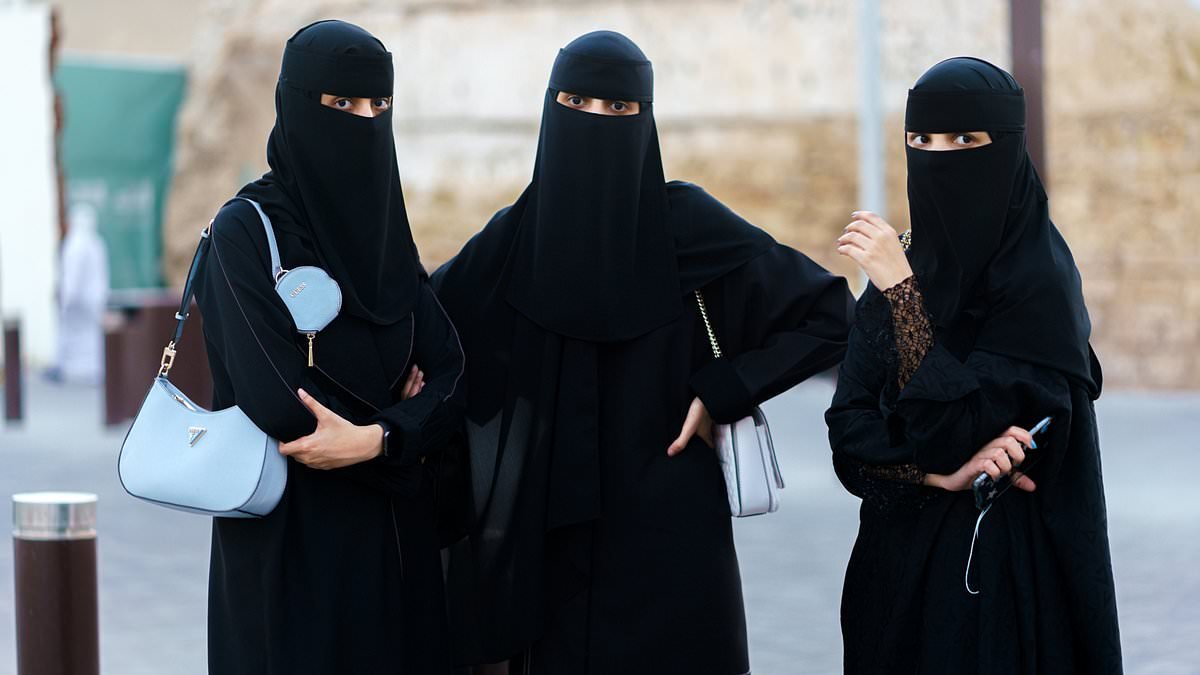
The Balearic Islands have considered a total ban on burkas and niqabs, threatening a £25,000 fine for those who repeatedly wear them (File photo)
She also criticised left-wing groups that did not support the law, accusing them of being ‘hypocrites and fake feminists’.
Canadas added that the ban on the burka and niqab in public spaces ‘is not an act of discrimination, but a measure of strict public order and national security’.
PP deputy Cristina Gil echoed a number of Vox’s arguments, while stressing that the party has been ‘saying for many years that the burka and niqab violate women’s dignity’.
Gil said that the proposed law ‘does not affect religious freedom’ but rather ‘restricts a practice that renders women invisible’.
The conservative politician also called out the left for ‘denying women’s right to exist’.
‘This is their kind of progressivism, for women who are fully veiled. They want to keep them hidden,’ she asserted.
She also justified the ban on these garments on security grounds, as they impede facial identification, and emphasised that the European Court of Human Rights has upheld the possibility of limiting the use of the full-face veil in public spaces.
However, the left-wing PSIB, MÉS per Mallorca, Més per Menorca, and Unidas Podemos groups have labelled the proposed law ‘racist’.
They have rejected the use of the burka and niqab, but have questioned Vox’s supposed concern for women.
PSIB deputy Teresa Suárez believes the proposed law is not about women’s freedom, but about ‘an obsessive idea of a supposed cultural threat’.
‘It uses the burka to talk about the incompatibility of Islam with our society,’ she said, adding that Vox’s objective is ‘to create a common enemy’.
France was the first European country to introduce a blanket ban on wearing burqas in public in 2011.
The list has expanded significantly since, with more than 20 states around the world implementing some form of ban on the burqa and other full-face coverings in public, including Austria, Tunisia, Turkey, Sri Lanka and Switzerland.
The European Court of Human Rights has consistently upheld these bans, including in 2017, when it upheld Belgium’s ban on burqas and full-face veils, ruling that states may restrict such garments to protect ‘living together’ in society.
Regions of Italy already impose restrictions, such as the northern region of Lombardy, which imposed a ban on entering public buildings and hospitals with covered faces in late 2015.
Portugal’s parliament approved in October a bill to ban face veils used for ‘gender or religious motives’ in most public spaces that was proposed by the hard-right Chega party and effectively targets burqas and niqabs worn by Muslim women.
Only a small minority of Muslim women in Europe cover their faces, and in Portugal, such veils are very rare.
But full-face coverings such as niqabs and burqas have become a polarising issue across Europe, with some arguing that they symbolise gender discrimination or can represent a security threat and should be outlawed.
The burqa is a full-body garment that covers a woman from head to foot, including a mesh screen over the eyes.
The niqab is a veil for the face that leaves the area around the eyes clear.