On a cold November morning in 1963, the world watched a scene that seemed almost impossible to comprehend.
A young president had been murdered in public. A nation was in shock. Governments around the world were shaken. Millions of Americans were searching for answers, trying to understand how a moment of hope and optimism could suddenly end in violence on the streets of Dallas.
And at the center of this unimaginable tragedy stood a woman who had just lost her husband.
Jacqueline Kennedy was only thirty-four years old. She was a widow, a mother of two young children, and a woman who had experienced one of the most traumatic moments ever witnessed by the American public. Yet in the days following President John F. Kennedy’s assassination, she displayed a level of composure and determination that surprised even those who worked closest with her.
Many expected her to disappear from public view. Many believed that the funeral procession should be conducted with maximum protection, maximum distance, and maximum caution.
After all, the president of the United States had just been killed.
Security officials were deeply concerned. The idea of world leaders walking openly through the streets of Washington, D.C., only days after an assassination seemed dangerous, even reckless.
But Jackie Kennedy saw something different.
She understood that the funeral was not only a farewell to her husband. It was a moment that would define how history remembered him. It was a message to America and to the world.
Fear could not be the final image.
The world needed to see courage.
The world needed to see democracy standing.
And the world needed to see that violence had not forced America to hide.
The decision that followed became one of the most unforgettable moments of the twentieth century.
On November 25, 1963, thousands gathered in Washington as foreign leaders, dignitaries, and American officials participated in President Kennedy’s funeral procession. Among those who walked were some of the most powerful figures on earth, including French President Charles de Gaulle, Ethiopian Emperor Haile Selassie, and Prince Philip representing the British royal family.
The route stretched from the White House area to St. Matthew’s Cathedral.
It was not a quick movement from one secure location to another.
It was a public statement.
The leaders walked through the streets, surrounded by security personnel who knew the risks. Secret Service agents and law enforcement officials remained alert, watching every window, every rooftop, and every person standing along the avenue.
For security professionals, the situation was terrifying.
They had just witnessed the assassination of a president. The possibility of another attack could not be ignored.
But Jackie Kennedy believed something equally important was at stake.
The funeral had to represent strength, not surrender.
A motorcade protected behind layers of metal and distance might have been safer. But symbolically, it would have sent another message — that fear had won.
Instead, the world saw leaders walking together.
They saw a grieving nation refusing to retreat.
They saw a widow who, despite unimaginable pain, understood the power of a single image.
Because Jackie Kennedy had always understood images.
Long before becoming First Lady, she had possessed a remarkable awareness of history, tradition, and symbolism. During her years in the White House, she had transformed the role of First Lady by bringing attention to art, architecture, culture, and historical preservation.
She understood that history was not remembered only through speeches and documents.
History was remembered through moments.
Through photographs.
Through scenes that remained in the public imagination long after the people involved were gone.
And after Dallas, she became determined that her husband’s final journey would be remembered with dignity.
One of the strongest influences on her decisions was another national tragedy that had happened almost a century earlier.
The funeral of Abraham Lincoln.
After Lincoln’s assassination in 1865, the nation had created an enormous mourning ceremony that stretched across cities and united a grieving population. Lincoln’s funeral included carefully chosen symbols: black decorations, a solemn procession, a catafalque carrying his coffin, and a riderless horse representing a fallen leader.
Jackie Kennedy reportedly looked to Lincoln’s funeral traditions as she helped shape the ceremonies for President Kennedy.
The comparison was powerful.
Both presidents had been assassinated.
Both had represented moments of national transformation.
Both had left behind grieving families and a country struggling to understand sudden loss.
By connecting Kennedy’s funeral with Lincoln’s, Jackie was not simply copying history.
She was placing her husband within a larger American story.
She was saying that his death was not only a personal tragedy. It was a national wound.
Every detail mattered.
The black-draped rooms.
The solemn military traditions.
The silence of the crowds.
The slow movement of the procession.
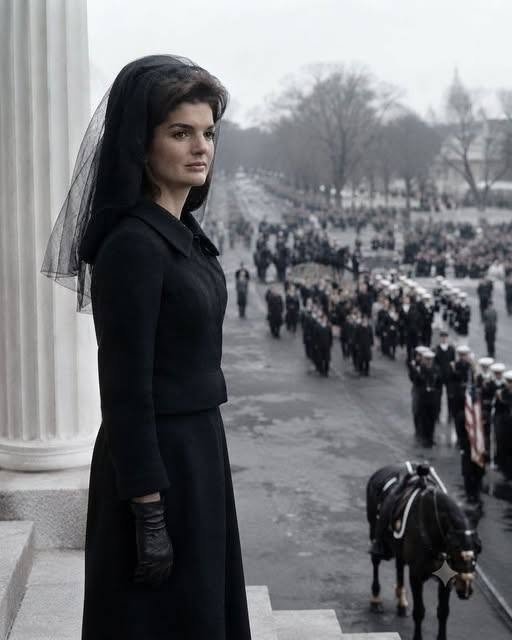
The riderless horse with empty boots facing backward in the stirrups.
To many viewers watching around the world, these images carried a meaning beyond words.
The horse seemed to represent absence.
The empty boots represented the person who would never return.
The silence represented the shock of a nation that had lost its leader.
And standing behind it all was Jackie Kennedy, walking with incredible strength while carrying a grief that the world could see.
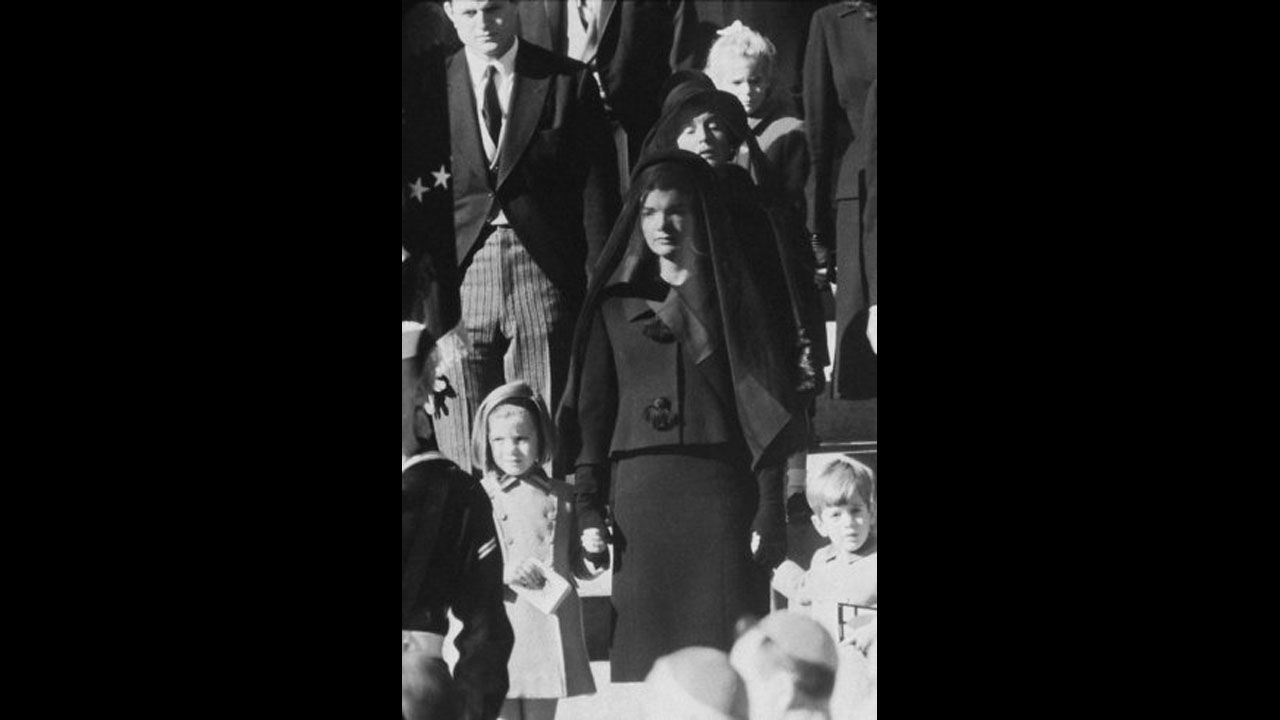
One photograph from those days became especially powerful.
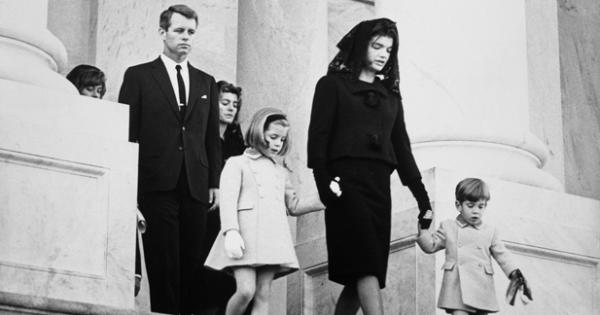
Jackie Kennedy standing beside her children during the funeral.
Her two-year-old son, John Jr., saluting his father’s coffin.
The image became one of the most emotional photographs in American history.
Millions saw a child trying to understand a loss far too great for someone so young.
They saw a mother guiding her children through unimaginable pain.
They saw a family mourning not behind closed doors, but before the entire world.
The image was heartbreaking because it was human.
Behind the political power, behind the presidency, behind the history books, there was simply a family saying goodbye.
That was perhaps Jackie Kennedy’s greatest understanding.
She knew that people do not remember history only through facts.
They remember feelings.
They remember faces.
They remember moments when the entire world seemed to stop.
The days after Kennedy’s assassination were filled with uncertainty. The country was experiencing one of the darkest moments of the modern era. Rumors spread. Questions remained unanswered. Americans struggled with fear and confusion.
But the funeral provided something people desperately needed.
A sense of order.
A sense of ceremony.
A way to express collective grief.
Funerals are not only about the person who has died. They are also about helping those who remain.
They create a shared moment where people can acknowledge loss together.
Jackie Kennedy understood this instinctively.
She was not simply planning a funeral for her husband.
She was helping a wounded nation mourn.
The decision to walk through Washington became one of the clearest examples of her understanding of symbolism.
The leaders who followed behind the coffin were not just attendees.
They were representatives of the world.
Their presence showed that Kennedy’s death had significance far beyond America’s borders.
The young president had become a global figure, and his funeral reflected that reality.
The procession also sent a message about democracy itself.
Assassination attempts throughout history have often been designed to create fear, instability, and uncertainty.
But the funeral procession showed the opposite.
The government continued.
The nation continued.
The world continued.
The streets remained open.
The leaders walked forward.
And the image of that walk became stronger than the violence that had caused it.
Decades later, historians continue to study Jackie Kennedy’s actions during those days because they reveal something rare: the ability to think clearly while experiencing overwhelming personal suffering.
Many people collapse under grief.
Many people retreat.
Jackie Kennedy moved toward responsibility.
She made decisions while carrying a burden that few people could imagine.
She was not without pain.
She later spoke openly about the trauma of those days and the lasting impact of losing her husband.
But during those critical hours, she focused on something larger than herself.
She focused on memory.
She focused on meaning.
She focused on what future generations would see when they looked back at November 1963.
And that is why the funeral remains one of the most carefully remembered moments in American history.
Because it was not only about death.
It was about how a nation responds when confronted with tragedy.
It was about whether fear controls the final image.
Or whether courage does.
The photograph of the procession, the image of world leaders walking through Washington, the sight of a young widow standing with dignity beside her children — all became part of a historical memory that continues decades later.
Perhaps that was exactly what Jackie Kennedy wanted.
Not to erase the tragedy.
Not to pretend the pain did not exist.
But to ensure that the final images of her husband’s presidency were not defined only by violence.
They were defined by honor.
By unity.
By a nation standing together.
In the end, the most powerful thing Jackie Kennedy created was not merely a funeral ceremony.
She created a moment of remembrance that allowed millions of people to grieve.
She transformed personal sorrow into a public symbol of resilience.
:max_bytes(150000):strip_icc():focal(683x354:685x356)/jfk-jackie-1963-112525-ee396a745f4e439098403a36f1ba3b13.jpg)
And that November, when the world watched those leaders walk through the streets of Washington, they witnessed something extraordinary:
A country mourning its fallen president.
A family saying goodbye.
And a woman who, even in the darkest moment of her life, understood the unforgettable power of history.
Which image from those November days has stayed with you the longest?
Was it the young boy’s salute?
The riderless horse?
The silent procession?
Or Jackie Kennedy herself — walking forward when the entire world was watching?