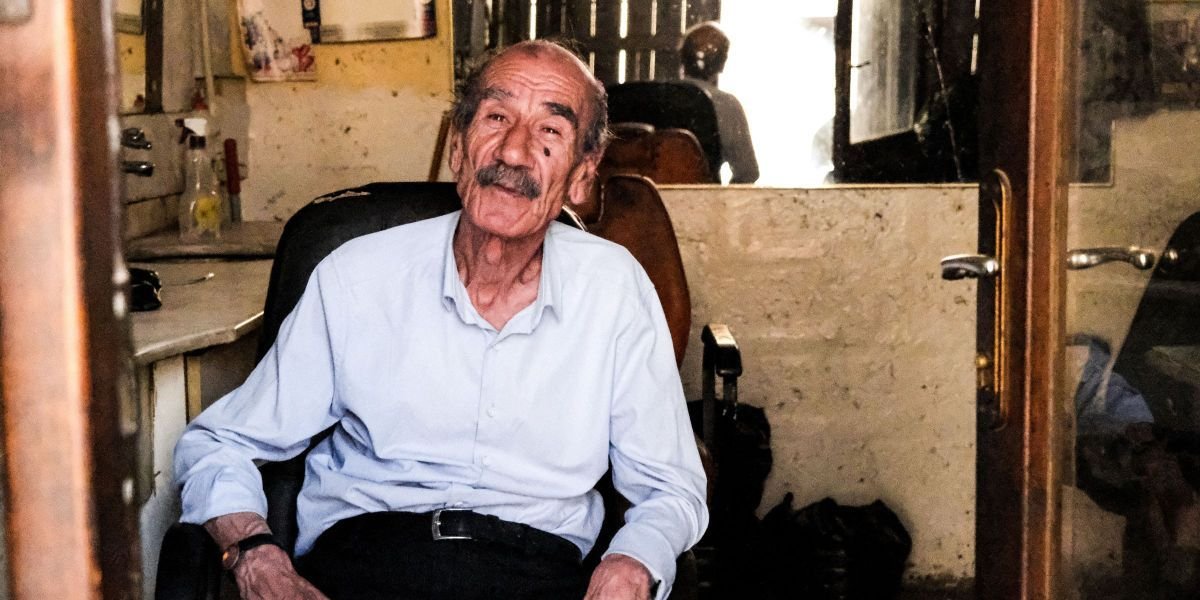
Before choosing to cut the homeless man’s hair, I noticed something on his wrist that stopped me cold. I thought I was simply helping a man who needed a chance, only to realize that fate had brought us together.
The moment I saw the bluebird tattoo on his wrist, I almost dropped my scissors.
I’d seen that exact bird before.
Same faded blue ink. Same raised wings. Same tiny, crooked tail.
I almost dropped my scissors.
My mother had worn it on her wrist for as long as I could remember.
The homeless man sitting in my salon chair had walked in 10 minutes earlier with one dollar in his pocket and a job interview the following morning.
And I was starting to realize he hadn’t walked into our salon by accident.
My mother had worn it on her wrist.
My shift was almost over when he came in.
I was cleaning my station while my co-worker, Brittany, finished with a client two chairs over.
The older man stood near reception.
His clothes were old and dirty; his hair had grown past his collar, and one shoe was splitting at the sole.
Something about his face was gentle.
He had a kindness in his eyes that reminded me of my grandfather.
“I have a job interview tomorrow,” the man told our receptionist, Melissa. “I can pay a dollar today. Maybe the rest next week?”
He unfolded a dollar bill he’d been holding in his palm.
“I can pay a dollar today.”
Then she looked at him. And then at his damaged shoes, especially the one with the split sole.
“A haircut is $50,” Melissa said. “You need to leave.”
Behind me, another stylist rolled her chair away.
“I could sweep up,” he offered. “Clean something. Whatever you need. Please. Nobody’s called me for an interview in months.”
Our manager, Denise, heard the conversation and came out of the back room.
“You’re holding up paying customers.”
He folded the dollar into a tiny square and slipped it into his pocket. Then he turned toward the door.
He turned toward the door.
The faded bluebird tattoo. The same one my late mother had.
I pointed toward my station.
“It’s 5:30 p.m. I’m done for the day.”
“If you’re giving away a haircut, then the cut comes out of your pay.”
I don’t know whether it was the tattoo or his face. Maybe both.
“You don’t have to do that,” the man said tentatively.
His expression changed for half a second. I noticed it.
At the time, I didn’t understand it.
Miles lowered himself into my chair as if he were afraid it might break or worried I might change my mind.
I fastened the cape around his neck.
“Whatever makes me look employable.”
“You already look employable.”
He smiled at me in the mirror.
“Then make me look like somebody who owns a comb.”
Miles barely spoke after that. But he kept watching me in the mirror.
It felt more like he was trying to remember something.
Every few minutes, the homeless man’s eyes filled with tears.
I pretended not to notice.
Then his sleeve shifted again.
I couldn’t stop thinking about the tattoo, but I didn’t want to ask a stranger what it meant.
Mom had died six years earlier.
Whenever I asked about her tattoo as a kid, she’d cover it with her hand and smile.
I pretended not to notice.
“One I’ll tell you someday.”
But “someday” never came.
I trimmed the last strands above Miles’s collar.
“There. What do you think?”
For several seconds, he said nothing.
I stepped back, thinking he was moved because I had been kind to him. But it was something else.
“You don’t need to apologize.”
He looked at me in the mirror.
“Your mother asked me never to contact you.”
“But I don’t have much time left.”
I moved around the chair until I was facing him.
“W… what do you mean? Do we know each other?”
Miles reached into the inside pocket of his coat, his eyes still wet.
“I’ve been looking for you for years. I had almost given up.”
Then he pulled something out.
“And I have a surprise for you.”
And forgot how to breathe.
It was an old photo of my mother.
She couldn’t have been older than 19.
Her hair was long, and she was laughing at whoever held the camera.
Beside her stood another teenager.
I looked between the photo and the man sitting in my chair.
In the picture, he and Mom had an arm around each other’s shoulders.
Both were holding up one wrist.
Two fresh bluebird tattoos.
The homeless man’s eyes filled again.
“My name is Miles.” He also gave me his last name, which happened to be my mother’s maiden name.
I sat down in the empty chair beside him.
“What? My mom didn’t have a brother.”
“No, that’s impossible. She was an only child.”
My mother had never mentioned him.
“We went into foster care when I was nine, and Sarah was 11. Our dad had already left. Our mom couldn’t take care of us anymore.”
My mother’s name was Sarah.
Hearing him say it made everything feel more real.
“We went into foster care.”
“We didn’t always get placed together,” he continued. “Sarah hated that. Every time we were separated, she’d tell me we’d find each other again.”
“When she turned 18, and I was 16, we stayed in the transition house at the same time. We decided we needed something that meant we’d always be family, even if life separated us.”
“Sarah chose them. She said birds could always find their way home.”
I looked at his wrist, then at the photo.
“Why did she tell me she was an only child?”
He told me what happened next.
He and Mom stayed close through their 20s. Mom found steady work, met my father, and built the stable life she’d always wanted.
He bounced between jobs and apartments. He borrowed money from Mom, paid some back, then needed help again.
“I wasn’t a bad person,” he explained. “But I wasn’t dependable. Your mother couldn’t build her life around wondering whether I’d show up asking for help.”
Miles met me twice as a baby. I have no memory of it.
He smiled when he told me.
“You pulled my beard so hard I thought you were going to take it with you!”
I laughed despite myself.
Then his face became serious.
“When you were six, Sarah told me she couldn’t keep doing it. She said she loved me, but she needed stability for you.”
“No. She set a strong boundary. There’s a difference.”
That sentence stayed with me.
Miles didn’t blame her. He said Mom made him promise not to contact me.
“She couldn’t keep doing it.”
The homeless man’s face crumpled.
“I didn’t know she’d died.”
After a while, Denise came over and quietly told me she was locking up.
Only then did I realize everyone had left.
I offered to take Miles to the diner across the street. I still had a few questions.
He tried to refuse. I bought him dinner anyway.
Over grilled cheese and coffee, he told me the rest.
He’d eventually gotten his life together.
For almost 15 years, he’d worked in maintenance at an apartment complex. He had a small place, friends, and enough money to live on.
Then the building was sold.
The new owners replaced most of the staff.
He lived off his savings while searching for another one. Then came a medical issue, bills, and rent he couldn’t keep up with.
Eventually, he lost his apartment.
“So you’ve been homeless since?”
“About four straight months.”
“What did you mean when you said you don’t have much time left?” I asked, tearing up involuntarily.
“You said you didn’t have much time left!”
I put both hands over my face.
“You can’t say something like that while crying!”
“I’m so sorry. If I don’t get steady work soon, I’ll be in trouble. The temporary housing program I’m in can’t hold my spot indefinitely.”
“Interview tip number one: ‘Work on your phrasing.'”
That was the first time we laughed together!
Then I asked the question that had been bothering me.
Miles reached into his coat again.
This time, he removed a folded newspaper clipping.
“I came across this by chance three years ago.”
He’d searched for Mom online after finally deciding he wanted to apologize and make amends, even if all he could do was send a letter.
Instead, he found her obituary.
From there, he found my mother’s Facebook profile. Her profile was public, and she’d posted pictures from my birthday two years earlier.
One showed me standing inside the salon, with the name visible behind me.
Our website had a staff page.
“So you knew exactly where I worked?”
“Then why didn’t you just come in and tell me who you were?”
The day he finally came in was a Thursday.
“I stood across the street for 30 minutes. Then I left.”
He returned Tuesday and Wednesday.
Each time he’d lost his nerve.
“What were you afraid of?” I asked.
“That you’d tell me to go.”
His answer was so simple it hurt.
Even after discovering she was gone, he couldn’t decide whether breaking that promise would dishonor her.
Then a warehouse nearby called him for an interview.
He needed a haircut, and he only had one dollar.
“What were you afraid of?”
“So today,” he said, “I decided I’d come in as a customer.”
“I wasn’t planning on staying or telling you who I was. I thought I’d ask about the haircut, see you for a bit, and leave.”
“Then why did you tell me?”
“I wasn’t planning on staying.”
“Because you gave up part of your pay to help somebody you thought couldn’t give you anything back.”
“That’s exactly what Sarah would’ve done,” he said, choking on my mom’s name.
I looked away because I was crying too.
Then he pushed the photo toward me.
My mother’s handwriting was on the back.
“Miles and Sarah. Still flying home.”
Underneath was a date from almost 30 years ago.
“There’s something else,” Miles said.
From another pocket, he removed a small silver locket.
“I’ve kept this longer than almost anything I own.”
Inside was a tiny photo of Mom.
On the other side was a folded piece of paper, cut small enough to fit inside.
“For Miles. So wherever we end up, you’ll know you still have family.”
Miles reached across the table.
He just left his hand there.
Miles reached across the table.
The next morning, I drove him to his interview, although I wasn’t sure how to receive him.
I’d also brought a pair of shoes and formal clothes my neighbor’s husband no longer wore.
When Miles saw the clothes, he shook his head.
“Emilia, you’ve already done enough.”
“Your current shoe is trying to become a sandal.”
He looked down at the split sole.
Before getting out of my car, he checked his hair in the mirror.
“Like somebody who owns at least two combs.”
Then his expression changed.
“Whatever happens in there, thank you.”
“Go get your job, Uncle Miles.”
It was the first time I’d called him that.
“Oh, don’t start,” I said. “I spent half of yesterday crying.”
He laughed, wiped his eyes, and went to a public restroom to change.
He called me that afternoon from someone’s phone after I’d shared my number with him the previous day.
I answered during my break.
“They want me on Monday.”
I screamed loud enough that Brittany dropped a brush!
“I guess the haircut worked!”
“The stylist was exceptional.”
“I heard she’s expensive.”
Two months later, Miles moved into a room in a shared house.
Three months after that, he came into the salon again.
This time, he wore clean work clothes.
Denise was at the reception.
“I have an appointment with Emilia.”
“You’re the professional.”
When I finished, he handed over $50.
I tried to return it. He refused.
Then he placed something else beside it.
“You’re the professional.”
A dollar bill folded into a tiny square.
“I believe I promised the rest the following week.”
“You’re several months late.”
Then Uncle Miles lifted his wrist.
The bluebird was still there. I was wearing the locket Mom had given him.
I’d spent my whole life thinking Mom’s tattoo represented a story she’d taken with her.
Instead, it led part of her family back to me.
I was wearing the locket.
My uncle couldn’t replace Mom, but he gave me something different.
- The ridiculous haircut she gave herself at 16.
- The summer she lived on peanut butter sandwiches to save for her first car.
- How she’d protected her little brother even while being a kid herself.
He gave me something different.
And I gave him something, too.
- A place at Thanksgiving.
- A spare key to my apartment.
- Someone to call when he got good news.
Time didn’t erase the years we’d lost.
It just meant we didn’t have to lose any more.
Every few weeks, Uncle Miles still sits in my chair, and I cut his hair.
He still tries to overpay me.
Whenever I see that bluebird on his wrist, I think about what Mom once told him.
Birds can always find their way home.