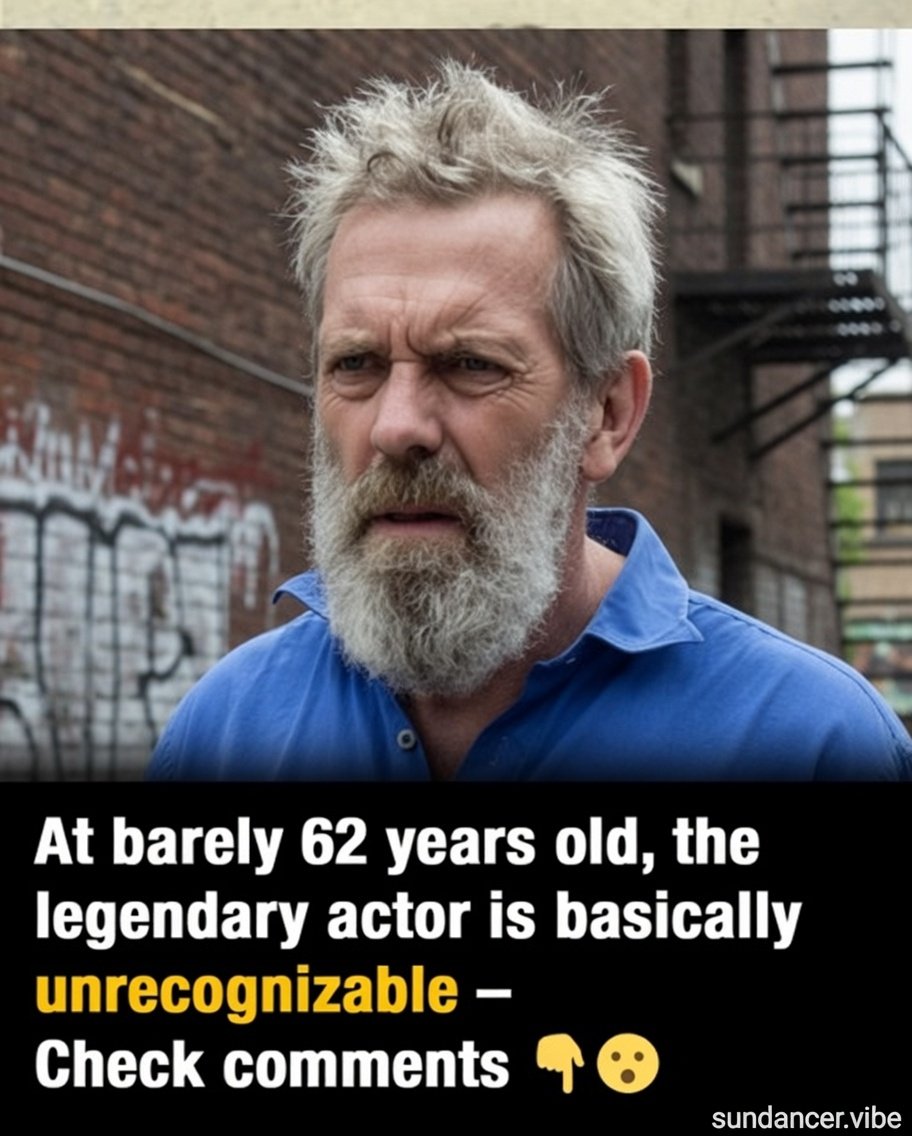
For millions of viewers around the world, Hugh Laurie will always be remembered as the brilliant, sharp-tongued Dr. Gregory House from House—a character so convincing that many people forgot they were watching an actor at all. Yet behind that performance was a quiet, persistent feeling that success alone couldn’t erase. Despite earning extraordinary recognition and reportedly commanding one of the highest per-episode salaries in television at the height of the show’s popularity, Laurie has openly admitted that playing a doctor on screen sometimes felt like a substitute for something more meaningful he never pursued. His reflections reveal a deeply personal conflict—not about fame or achievement, but about expectation, identity, and the path he chose to take. While audiences saw confidence and brilliance in his portrayal, Laurie himself often saw a gap between the life he lived and the one he once considered. That contrast, between perception and reality, became more pronounced over time, especially as he looked back on the influence of his father and the direction his own life had taken.
Laurie’s father, a respected physician and accomplished individual in his own right, had envisioned a similar future for his son. Growing up, Laurie was not disconnected from that world. In fact, he seemed to be moving toward it. He attended the same academic environment tied to University of Cambridge where his father had studied, and he demonstrated discipline and ambition through rowing, even training at a competitive level. At that stage in his life, medicine wasn’t just an abstract idea—it was a realistic possibility. But like many turning points, the shift came quietly rather than dramatically. Laurie discovered performance, comedy, and storytelling through the Cambridge Footlights, a decision that would ultimately define his career. It was there that he crossed paths with future collaborators like Emma Thompson and Stephen Fry, relationships that would open doors into a completely different world. What began as creative exploration gradually became a career path, and before long, the idea of becoming a doctor faded into something more distant—still present, but no longer central.
As his acting career developed through the 1980s and 1990s, Laurie built a strong reputation in British television, particularly with shows like Blackadder. His work showcased versatility, intelligence, and a unique comedic timing that set him apart. He transitioned into film roles as well, appearing in projects like Sense and Sensibility and later reaching broader international audiences with performances in productions such as 101 Dalmatians. Yet nothing compared to the breakthrough that came in 2004, when he was cast as the lead in House. The role transformed him into a global star almost overnight. His portrayal of a complex, flawed, and intellectually gifted doctor resonated deeply with audiences, and his ability to adopt a convincing American accent added another layer of immersion to the character. Over eight seasons, Laurie became synonymous with the role, earning awards, critical acclaim, and a devoted fan base. From the outside, it looked like the pinnacle of success. But internally, the experience carried a different weight.
During and after the show’s run, Laurie spoke candidly about the emotional challenges that accompanied such intense work. The demands of maintaining that level of performance, combined with his own personal standards, led to periods of exhaustion and darker moments that he later described openly. He maintained a strict work ethic, rarely missing filming, pushing through even when he felt mentally and physically drained. At times, he admitted to wishing for an external reason—an interruption, even an accident—that might give him a break. These admissions didn’t reflect dissatisfaction with his career itself, but rather the pressure that came with sustaining it at such a high level. And layered beneath all of that was the quieter, more personal reflection about his father. While Laurie had achieved extraordinary success, he couldn’t fully shake the idea that he had taken a different path than the one expected of him. Playing a doctor on television, no matter how convincingly, wasn’t the same as becoming one in reality. That distinction, though subtle to outsiders, carried emotional significance for him.
What makes Laurie’s perspective particularly compelling is the honesty with which he frames it. He doesn’t diminish his achievements, nor does he reject the value of his work. Instead, he acknowledges a dual reality: one where he is grateful for his career and another where he still wonders about the road not taken. His description of himself as playing a “fake version” of a doctor isn’t meant to undermine his performance—it’s a reflection of that internal comparison. For Laurie, the idea of becoming a doctor wasn’t just about a profession; it was about continuity, about following in his father’s footsteps, about fulfilling an expectation that had shaped part of his identity. When he speaks about feeling like he chose a “shortcut,” it reveals how deeply he values effort, discipline, and the kind of contribution he associates with medicine. At the same time, it highlights a universal theme: the tension between what we achieve and what we imagine we could have been. Many people experience this in different ways, measuring their paths against expectations—whether from family, society, or themselves—and wondering how those choices define them.
In the years since House ended, Laurie has continued to take on diverse roles, including projects like Veep and the series Chance, where he again portrayed a doctor, though in a very different context. These roles demonstrate that his connection to that world, even symbolically, hasn’t entirely disappeared. Yet his reflections suggest that the question was never about returning to medicine—it was about understanding the meaning of his choices. What his story ultimately reveals is not regret in the traditional sense, but awareness. The awareness that success in one area doesn’t erase curiosity about another. The awareness that identity is shaped not only by what we do, but by what we choose not to do. And perhaps most importantly, the awareness that even at the highest levels of achievement, people continue to reflect, question, and redefine what fulfillment means to them.