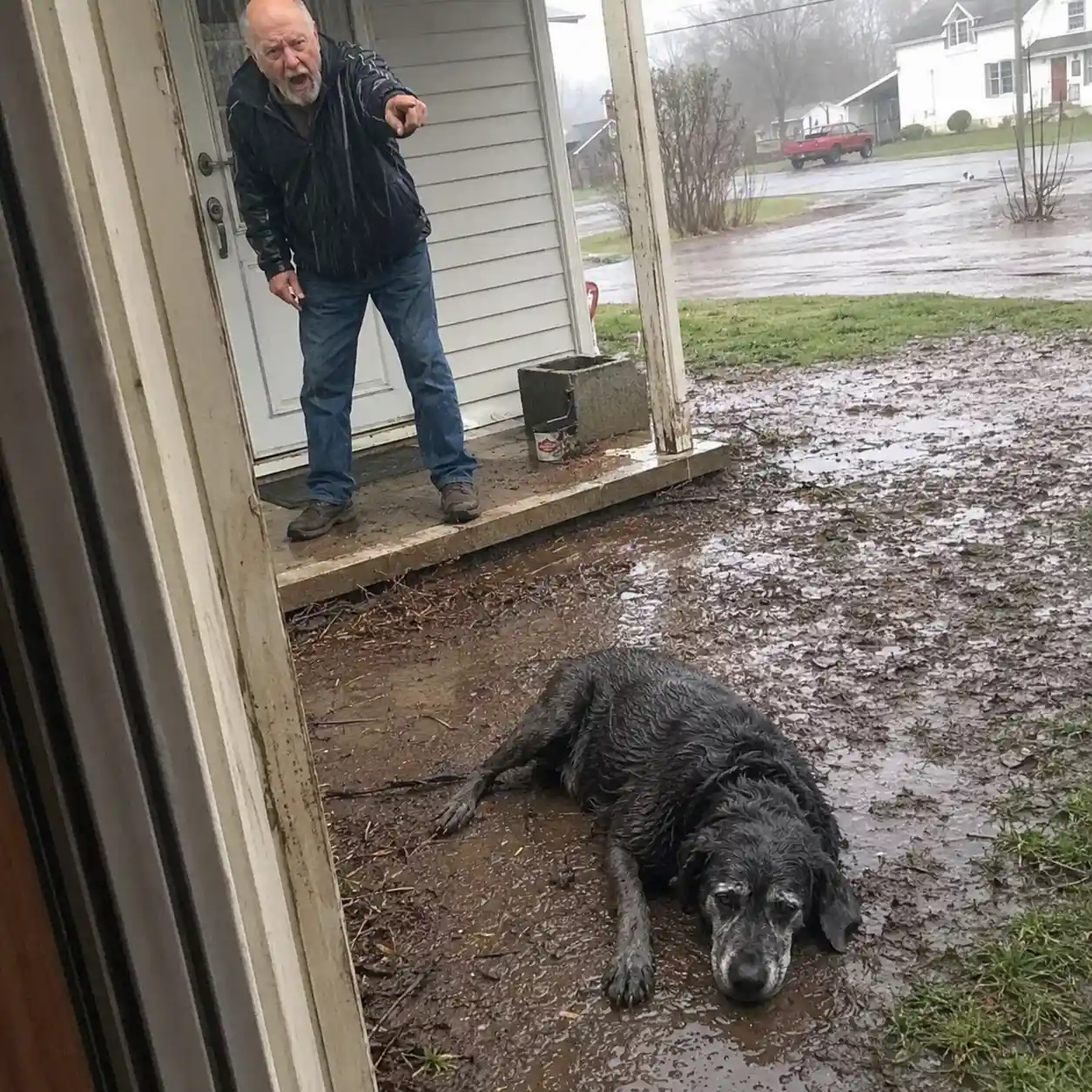
My neighbor kicked his old dog into the freezing rain like the animal was nothing.
I was standing at my kitchen window with my coffee. The thermometer on the porch read 41 degrees, and the rain was coming down sideways.
The dog was a gray-faced Lab, maybe 13 years old. He hit the mud and didn’t even try to get up. He just lay there while the rain hammered his ribs.
Mr. Callahan slammed his door. The porch light went dark.
Before my brain could catch up, my own back door banged open.
My son Eli is six. He was in his pajamas. No shoes, no coat.
He ran barefoot through the mud and dropped to his knees beside that dog. Then he did the thing that broke me in half.
He pulled off his own little dinosaur jacket and wrapped it around the dog’s shaking body. Then he laid down in the mud next to him and held on.
I ran out screaming his name. I was ready to grab my boy with one arm and pound on that old man’s door with the other.
But when I reached them, Eli looked up at me with rain running down his face. “Daddy, he’s crying,” he said. “Buddy is crying.”
And God help me, he was. That old dog was making a sound I have never heard an animal make. Not whimpering. Something deeper. Something worse.
Then the porch light snapped back on.
Mr. Callahan stepped out into the rain in his slippers. Seventy-four years old, soaked in ten seconds, staring at us. I stepped in front of my son. I was ready for a war.
But he didn’t yell. He didn’t even look angry.
He looked at that dog like he was looking at a ghost. His whole face collapsed, and when he finally spoke, his voice came out cracked and small.
“You don’t understand,” he said. “That dog was never mine. He was my Martha’s. And the night she died, he was the only one who tried to save her.”
The rain kept falling. Nobody moved.
I’d talked to Frank Callahan maybe a dozen times in six years. A wave over the fence. Some complaining about the county. I borrowed a ladder once. I knew his wife had passed back in June. We’d sent a card. My wife Sarah made a casserole.
Standing there in the rain, I realized I did not know the man at all.
“Frank,” I said. “Let’s get out of this weather.”
He shook his head. He couldn’t stop looking at Buddy, wrapped in my son’s jacket, shaking in the mud.
“Thirteen years,” he said. “Thirteen years and I never once raised a hand to that animal. Martha would’ve skinned me alive.” His voice broke on her name. “You must think I’m a monster.”
Sixty seconds earlier, I had.
Eli stayed on the ground with his arms around the dog’s neck. Sarah appeared at our back door with towels, yelling something the rain swallowed. And Frank Callahan, this quiet old man I’d waved at for six years, stood there in his soaked slippers and told us about the night his wife died.
“She had a stroke,” he said. “Sometime after midnight. I’d fallen asleep in my chair downstairs, watching the TV. I do that. Did that.” He wiped his face, and I don’t think all of it was rain. “Buddy started scratching at the bedroom door. Barking. Carrying on like the house was on fire.”
He stopped. A car hissed past on the wet road, and he waited for it to pass, like the next words needed silence.
“I hollered at him,” he said. “I hollered at that dog to shut up and let an old man sleep. He kept on for a while. I don’t know how long. Then he stopped.”
My stomach dropped through the ground.
“I found her at six the next morning. Buddy was laying against the bedroom door. He looked up at me, and I swear on my life, that dog knew before I did.”
Nobody said anything. Even the rain seemed to fall softer.
“The doctor said with strokes, you get a window. A few hours, maybe. Get help fast enough and sometimes…” He didn’t finish the sentence. He didn’t have to.
“Frank,” I started, but he wasn’t done.
“Every night since June, that dog scratches at her door. Every single night. And every time I hear those claws on the wood, I’m back in that recliner, hollering at the only one in the house who was trying to save her.” His hands were shaking now. “Today would’ve been her birthday. He started scratching at six this morning and something in me just…”
He looked down at the dog, and his face crumpled like paper.
“I didn’t mean it,” he whispered. “Buddy. I didn’t mean it.”
The dog’s tail moved. Just once, just the tip of it, slapping the mud. Thirteen years old, kicked out into the freezing rain, and that tail still moved for him.
I will never get over that.
Sarah got everybody sorted. That’s her gift. She just starts moving people and they move.
Frank wouldn’t come inside. He backed toward his door saying he was sorry, saying it over and over, and then he was gone and his house went dark.
We carried Buddy into our kitchen. Sarah toweled him off while Eli held his big gray head and talked to him the way six-year-olds talk to animals. Full sentences. Total confidence that he was understood.
“You can live here now,” Eli told him. “We have good snacks. My dad snores too, but you get used to it.”
Buddy was in rough shape. You could count his ribs through the wet fur. His back hips clicked when he walked. The vet would tell us later he had arthritis, an ear infection, and three teeth that needed to come out. Grief doesn’t just starve the person left behind. It starves everything in the house.
But that first night, we made him a bed out of camping foam and old quilts, and Eli dragged it inch by inch across the kitchen floor until it sat under the window. The window that faced Callahan’s house.
I asked him why there.
“So Buddy can watch his other house,” Eli said, like it was the most obvious thing in the world. “You don’t stop loving somebody just because they made a mistake.”
Six years old. I don’t know where he gets it. His mother, probably.
Buddy settled in the way old dogs do. Quiet. Grateful. Constantly underfoot.
He followed Eli everywhere. Sat outside the bathroom door. Slept against his bed at night, though the stairs took him three tries, so eventually we just moved his quilts up to Eli’s room for good.
But every day, sometime around six, he’d go to that window. He’d rest his gray muzzle on the sill and stare at the dark house next door. He never barked. He just watched, and waited, and after a while he’d sigh from somewhere way down deep and go lie down.
Meanwhile, Frank Callahan disappeared inside his own home.
His truck never moved. His mail piled up until the carrier started wedging it behind the storm door. His lights came on at strange hours, two a.m., four a.m., and burned until dawn.
Sarah left a casserole on his porch. He never took it in. A raccoon did.
Eli asked me questions I didn’t have good answers for.
“Is Mr. Callahan sick?”
“Sort of, buddy.”
“Does he miss Buddy?”
“I think he misses a lot of things.”
“Then why doesn’t he just say sorry? That’s what I have to do.”
I told him it was complicated. Which is what parents say when the answer is yes but the world is stupid.
Nine days after the rain, Buddy went missing.
Eli had left the back door cracked while bringing in firewood, and by the time we noticed, the yard was empty. My chest did that thing where it forgets how lungs work. A 13-year-old dog with bad hips, out in February.
We found him in four minutes. He hadn’t gone far.
He’d crossed both yards and climbed Frank Callahan’s porch steps, one at a time, the hard way. And he was lying against the front door. Pressed right up against it, nose to the weather stripping, on a mat that still said WELCOME.
Waiting to be let in.
Eli started up the steps and I caught his shoulder. I knocked instead. Nothing. I knocked harder. I could hear the TV going in there. Some game show. Applause.
“Frank. It’s Dave from next door. Your dog’s on the porch.”
The TV went silent. Then his voice came through the wood, close, like he was standing a foot away. Like maybe he’d been standing there a while.
“He ain’t my dog no more.”
“Frank, come on. He walked over here on those hips. He wants to see you.”
A long pause. When the voice came back, it was ragged.
“Take him home, Dave. Please. He deserves better than what’s in this house.”
Buddy scratched at the door. One paw. Slow. Deliberate. Claws on wood.
And through that door I heard a sound I never want to hear again. A 74-year-old man coming apart on the other side of an inch and a half of oak.
I carried Buddy home. All sixty-some pounds of him. He watched that house over my shoulder the entire way.
Eli cried at dinner. Sarah looked at me over his head.
“Go back,” she said. “Tonight.”
He let me in the second time. I think he only opened the door because I’d brought a six pack and stood there long enough to prove I wasn’t leaving.
His house stopped my heart a little.
Not because it was messy. Because it wasn’t. Every surface was clean, and every single thing on every surface was Martha’s. Her reading glasses on the arm of the chair. Her crossword book, still open, pen resting in the crease. A tube of hand lotion on the kitchen table. The man was living inside a museum where he was both the guard and the exhibit.
Her slippers still sat by the bedroom door.
The bedroom door with the scratch marks. Hundreds of them. Pale little lines worn into the stain, low down. Thirteen years of a dog asking to be let in where his people were. And one fresher set, deeper than all the rest, from a single night in June.
Frank saw me looking. He handed me a beer and sat down heavy.
“She found him at the shelter,” he said. “Somebody dumped a whole litter. All his brothers got picked and he didn’t. Martha said that settled it. She wasn’t going to let him be the last one left twice.”
He smiled at the table.
“Named him Buddy because she said that’s what he was going to be. She wasn’t creative, my Martha. Just right about everything.”
We drank our beers and he talked. How the dog rode shotgun to her chemo appointments years back, when they thought they’d lose her the first time. How he slept with his head on her feet through the whole recovery. How she’d talk to him all day long, narrating her errands, the way some wives do with dogs when their husbands run quiet.
“He was hers,” Frank said. “I was just the guy who bought the food.”
Then his face changed.
“You know what the worst part is? He doesn’t blame me. Thirteen years old, kicked out in the rain, and if I opened that door right now, he’d forgive me before he got up the steps. And I can’t…” His hands tightened around the bottle. “I don’t deserve that, Dave. I hollered at him to shut up while she was dying. A man doesn’t get forgiven for that.”
I’m not smart about these things. Sarah’s the talker in our house. But I said the only true thing I had.
“Frank, you didn’t know.”
“He knew,” Frank said. “He tried to tell me. That’s what kills me. He did his job. I’m the one who didn’t do mine.”
I had no answer for that. I’m not sure there is one. Not from another grown man, anyway.
Turns out the answer was four feet tall and had been eavesdropping on his mother’s phone calls.
Saturday morning, Eli was up before his cartoons even started, which never happens. He had his backpack on. He informed me, informed me, that we were taking Buddy to visit Mr. Callahan, and that he had made him something.
I warned him Mr. Callahan might not open the door.
“He will,” Eli said. “I’ll knock different.”
I have no idea what that means. I still don’t.
But we walked over. My son, that old dog laboring beside him, me trailing behind like security. Eli knocked. Different, apparently.
And Frank Callahan opened his door.
He looked terrible. He looked like a man who hadn’t slept since June, because he probably hadn’t. He stared down at Eli, then at Buddy sitting on the mat, tail sweeping the boards.
Eli pulled a piece of paper out of his backpack and held it up.
A crayon drawing. Three figures. A lady with gray hair in a purple dress. A yellow dog. An old man. All of them holding hands, or paws, under a sun wearing sunglasses.
“That’s your wife,” Eli said. “I remember her. She used to give me a treat so I could give it to Buddy. I remembered her dress.”
Frank took the paper like it might catch fire in his hands.
“My dad says Buddy tried to wake you up and you feel bad because you didn’t.”
“Eli,” I said. But Frank held up a hand. He was looking at my son like the boy was about to deliver a verdict. I suppose he was.
“Buddy wasn’t mad at you,” Eli said. “He wasn’t tattling either. He just couldn’t open the door. Dogs don’t have hands. That’s the whole problem.”
Frank made a sound. Half laugh, half something tearing loose.
“And anyway,” Eli said, shrugging the way kids do when they’re about to say the biggest thing they’ll say all year, “you’re the only one left who loves her the same amount as him. He doesn’t want a new house. He just wants you to stop being sad at him.”
The whole street went quiet. Or maybe just my ears did.
Frank Callahan lowered himself down onto his own doormat, all seventy-four years of him, and opened his arms. And that old dog walked into them like none of it had ever happened. Frank buried his face in Buddy’s neck and shook, and Buddy stood there and took it, tail going the whole time, doing his job. The one Martha assigned him thirteen years ago.
Being a buddy.
Eli patted them both on the head, one after the other, exactly the same. Then he looked back at me like, see? You just knock different.
Buddy lives with us now, officially. That’s what the vet records say, anyway.
The truth is more complicated, and a lot better.
Frank and I spent a Sunday cutting a gate into the fence between our yards. His idea. He did most of the work, too, and swore at my post-hole digger the entire afternoon. The man is good with his hands when they’ve got a purpose again.
So now both yards belong to Buddy.
He sleeps in Eli’s room every night. But every morning around eight, he takes himself through that gate, up Frank’s back steps, and starts his day shift. Frank walks him after lunch, slow, the two of them clicking down the sidewalk on bad hips. Buddy takes his afternoon nap in a patch of sun next to Martha’s chair.
Her crossword book is put away now, by the way. Her glasses too. There’s a big framed photo on the mantle instead, the one from their fortieth anniversary, where Frank can look at her on purpose instead of getting ambushed by her things in every room.
The scratched-up bedroom door is still scratched. Frank never sanded it down.
“Proof,” he told me once, tapping the marks. “Somebody in this house did right by her.”
Last Tuesday, a storm rolled in around dinner. Cold, gray, sideways rain. The exact same brand as that night back in February.
I was at the kitchen window with my coffee. Old habits.
And I watched Frank Callahan walk out into that rain with an umbrella, and stand at the bottom of his porch steps, holding it over a slow old dog while Buddy took his sweet time finding the right spot in the yard. Frank got soaked. The dog stayed dry. Neither of them was in any hurry.
Then my back door banged open, because of course it did, and a barefoot kid in pajamas went flying across the wet grass while his mother yelled about pneumonia from the doorway.
Eli ducked under the umbrella with them. And I watched that old man shift it over my son, then take off his own canvas coat and wrap it around the boy’s shoulders. Right there in the freezing rain.
Same yard. Same storm. Same jacket move, just going the other direction this time.
Back in February, I stood at this window and watched my neighbor kick his old dog into the rain, and I thought I knew exactly what kind of man lived next door.
My son knew better. He didn’t see a villain. He saw somebody crying, and he ran outside.
Straight into the storm, barefoot, with nothing but a jacket to give.
I think about that all the time now. The gate in the fence. The dog with two houses. The old man who eats Sunday dinner at our table and lets a six-year-old beat him at checkers. All of it exists because one little boy didn’t stop to put his shoes on.
Love doesn’t wait for boots, I guess.
It just runs.