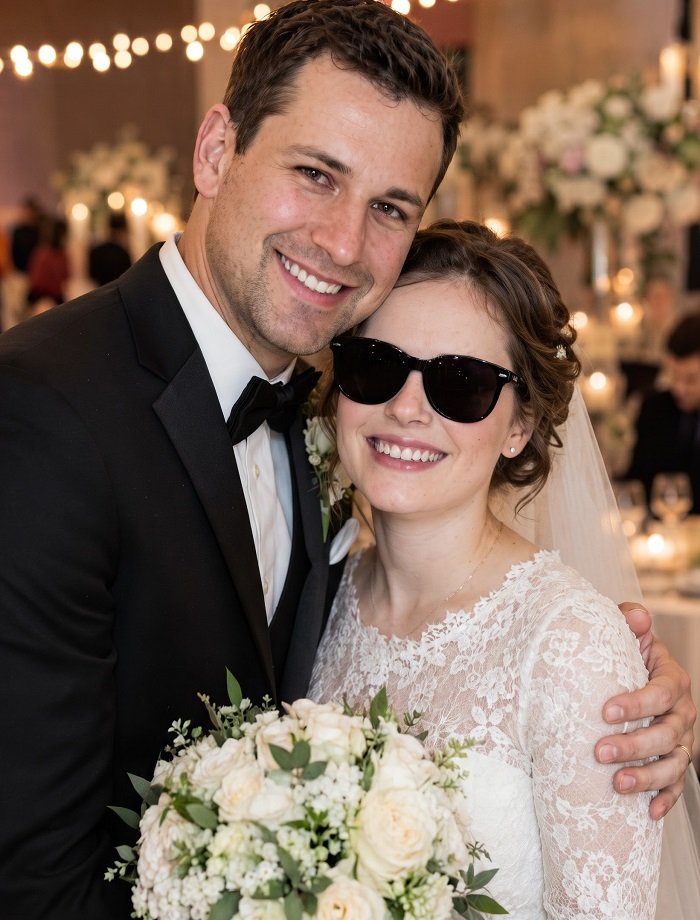
Part One: Less Than an Hour
My brother had been gone for less than an hour when my mother began asking about his will.
We were still standing beneath the harsh lights of the hospital waiting room. The surgeon’s words seemed to hang in the air around us.
“We did everything we could.”
I could barely understand what had happened. A few hours earlier, my brother Ed had been alive. He had been talking, breathing, and holding his wife’s hand.
Now he was gone.
His wife, Lily, stood beside me with one hand wrapped around her white cane. Her face was pale, and tears slipped silently down her cheeks. She looked as though the entire world had disappeared beneath her feet.
My mother noticed none of that.
Her eyes moved instead toward the thick envelope Lily was holding against her chest.
“What is that?” Mom demanded.
Lily tightened her fingers around it.
“It’s something Ed left for Alice.”
My mother’s expression changed immediately.
“Why would he leave something with you instead of giving it to his family?”
I stared at her.
“Mom, Ed just died.”
“I know exactly what happened,” she replied, her voice shaking. “That’s why we need to think clearly. We need his insurance papers, his banking information, the deed to the house, and whatever legal documents he signed.”
Lily turned slightly toward me.
“Alice,” she whispered, “please don’t let her read this before you do.”
The fear in her voice pulled me out of my shock.
I stepped between Lily and my mother.
“Give us a minute.”
Mom stared at me as though I had betrayed her.
“Alice, this concerns all of us.”
“No,” I said. “Whatever is inside that envelope concerns Lily and me.”
Mom opened her mouth to argue, but I took Lily gently by the arm and led her away.
We walked down the hallway until we reached the small hospital chapel. It was empty except for several wooden benches and a row of artificial candles glowing beside the wall.
Once the door closed behind us, the noise of the hospital faded.
Lily sat beside me and placed the envelope in my hands.
“Before you open it,” she said, “there’s something you need to understand.”
“What?”
“Your family never knew the real reason Ed married me.”
I looked at her, confused and wounded.
“They thought he married you because he loved you.”
“He did love me,” she said. “More than I knew how to deserve.”
Her voice trembled.
“But that wasn’t the entire reason.”
She placed both hands over mine.
“Ed made me promise that if anything happened to him, you would be the first person I told.”
I looked down at the envelope.
“What are you about to tell me?”
Lily drew in an unsteady breath.
“The truth about the last eighteen months of his life.”
Part Two: The Girl in the Yellow Dress
Ed first met Lily when he was nine years old.
She had recently moved into our neighborhood with her adoptive parents. She was a small, quiet girl who wore a yellow dress on the first day of school and carried a white cane that seemed almost as tall as she was.
Ed came home that afternoon talking about her as though he had discovered someone extraordinary.
“There’s a new girl in my class,” he announced at dinner. “Her name is Lily, and she can’t see.”
My father glanced up from his plate.
“Is that so?”
“She listens better than everyone else,” Ed continued. “She knew Mr. Carter was standing near the window because she could hear the traffic behind him.”
Mom smiled faintly.
“That’s impressive.”
“She doesn’t know where everything is yet,” Ed said. “So I told her I’d help.”
Mom’s smile tightened.
“That’s kind of you, Edward, but you don’t need to make her your responsibility.”
Ed frowned.
“She’s not a responsibility. She’s my friend.”
A few days later, he brought Lily home.
Before they entered the kitchen, I heard him whispering instructions to her.
“There’s a step here. The table is on your left. Alice is sitting near the window, and my mom is by the stove.”
Then, in a louder voice, he announced, “Mom, this is Lily. She can’t see our faces, so we should make sure our voices sound friendly.”
Lily laughed.
“I can still tell when people are pretending.”
Ed looked horrified.
“Mom isn’t pretending.”
My mother gave a small, uncomfortable laugh.
“Of course not.”
Lily extended her hand in the wrong direction. Ed gently guided it toward Mom without making her feel embarrassed.
That was how he was with her from the beginning.
He never pulled Lily through a room or spoke for her when she could answer for herself. He described things when she asked, stayed quiet when she wanted independence, and learned to walk at her pace rather than forcing her to follow his.
A month later, our families met at a neighborhood barbecue.
Lily’s adoptive parents told us that her biological mother had left the hospital shortly after giving birth. Lily had been born blind, and the woman had decided she could not care for her.
Lily’s parents had adopted her when she was only a few days old.
Ed listened to the story without speaking.
That night, he came into my bedroom while I was reading.
“Her first mother left her,” he said.
I closed my book.
“Yes.”
“Because she couldn’t see?”
“I don’t know, Ed.”
He sat at the foot of my bed, his face unusually serious.
“I’m never going to leave her behind.”
I smiled sadly.
“You’re nine years old.”
“That doesn’t change anything.”
At the time, I thought it was something a kindhearted child would say and eventually forget.
Ed never forgot.

Part Three: The Love Our Family Refused to Understand
As we grew older, Ed and Lily became inseparable.
He walked her home from school, studied with her in the library, and recorded textbooks when accessible copies were unavailable. In return, Lily helped him through every failure, disappointment, and moment of self-doubt.
She knew when he was pretending to be confident.
She knew when his jokes were covering fear.
She could recognize the difference between his ordinary footsteps and the heavier rhythm of a bad day.
People often assumed Ed was Lily’s protector.
They never understood how often she protected him.
During high school, Ed struggled with anxiety before exams. Lily would sit beside him and say, “Read the question aloud. You understand more when you hear yourself think.”
When he failed his first driving test, she teased him for weeks.
“You have working eyes and still hit the curb?”
He laughed so hard that his embarrassment disappeared.
After graduation, Ed proposed beside the old oak tree in the neighborhood park where they had spent countless afternoons as children.
Lily said yes before he finished asking.
I cried when they told me.
Mom did not.
At their engagement dinner, she smiled for photographs, complimented Lily’s dress, and raised her glass during the toast. Later, she pulled me into the kitchen.
“Your brother isn’t thinking clearly,” she said.
“He loves her.”
“Love doesn’t solve every problem.”
“What problem?”
Mom glanced toward the dining room.
“She will depend on him for everything.”
“That isn’t true.”
“She can’t drive. She can’t see paperwork. She’ll need help with the house, appointments, finances—”
“Lily has a job. She has lived independently since college.”
“That’s different from marriage.”
“No, Mom. It isn’t.”
Her voice fell to a whisper.
“Ed has his entire future ahead of him. He shouldn’t have to spend it taking care of someone.”
I stared at her.
“He doesn’t see it that way.”
“That’s because he has always had a savior complex.”
Before I could answer, Dad entered the kitchen. He must have heard at least part of the conversation, but he said nothing.
That was Dad’s habit.
Whenever Mom crossed a line, he stood close enough to hear but too far away to interfere.
Ed and Lily married anyway.
Their wedding was small and warm. Lily walked down the aisle holding her father’s arm, and Ed cried before she reached him.
During his vows, he said, “You taught me that love isn’t leading someone through darkness. It’s trusting them enough to walk beside you.”
Lily smiled through her tears.
For five years, they built a quiet life together.
They bought a modest house with a wide front porch. Lily filled the garden with herbs she could identify by scent and texture. Ed installed labels and small accessibility features throughout the house, though Lily teased him whenever he became overly helpful.
“You know I lived twenty-three years before marrying you,” she once told him.
“Yes, but were those years properly organized?”
She threw a dish towel at him.
Their home was filled with laughter, audiobooks, badly cooked dinners, and music playing too loudly on Saturday mornings.
I thought they had all the time in the world.
I was wrong.
Part Four: The Year We Failed to Notice
During the final eighteen months of Ed’s life, something changed.
At first, the differences seemed small.
He stopped coming to some family dinners. He canceled plans at the last minute. He looked thinner, but whenever I mentioned it, he blamed work.
One afternoon, Lily accidentally referred to a medical appointment.
“How did the appointment go?” I asked him later.
Ed smiled.
“It was routine.”
“What kind of appointment?”
“The kind where a doctor tells you to sleep more and stop eating terrible food.”
I laughed.
“You’ll never follow that advice.”
“Exactly. That’s why there’s no reason to worry.”
He changed the subject so easily that I let him.
At Christmas, he looked exhausted. In one family photograph, his smile appeared strained, but I noticed only months later.
Mom complained that he had become distant.
“Marriage has changed him,” she said.
“He’s busy.”
“He never used to miss important occasions.”
I defended him, but I never asked him what was truly happening.
Neither did Dad.
We all accepted the answer Ed wanted us to believe.
He was fine.
He was tired.
Work was demanding.
He would visit soon.
Behind those excuses, my brother was quietly preparing to die.
Part Five: Ten Hours
The phone call came on a Tuesday morning.
“Alice.”
Lily’s voice was barely recognizable.
“Ed collapsed. They’re taking him into surgery.”
For a second, I could not move.
“What happened?”
“They said something about his heart. Please come.”
I drove to the hospital without remembering most of the journey.
When I reached the surgical waiting room, Lily was sitting alone. Her cane rested across her knees, and both hands were clasped tightly around its handle.
I sat beside her.
“I’m here.”
She reached toward my voice, and I took her hand.
Her fingers were ice-cold.
“Have they said anything?”
“Only that the surgery is complicated.”
“How long has he been in there?”
“Two hours.”
We waited together.
The clock above the doorway seemed louder than everything else.
At the fourth hour, I brought Lily coffee she never drank.
At the sixth, I called our parents. They were several hours away and immediately began driving.
At the eighth, I tried to reassure Lily.
“Ed is stubborn. You know that.”
She gave me a faint smile.
“Yes.”
“He’ll fight.”
Her smile disappeared.
“Alice, you’re a good sister.”
Something about the words frightened me.
“Why are you saying that?”
She turned her face toward the surgical doors.
“Because he always believed you would do the right thing, even when it was difficult.”
Before I could ask what she meant, the doors opened.
The surgeon walked toward us.
I knew before he spoke.
His shoulders sagged. His hands were folded in front of him, and sorrow had already settled into his expression.
“I’m very sorry,” he said.
The room tilted.
I stood because my legs had forgotten how to bend. Somewhere nearby, a machine beeped. A nurse crossed the hallway. The world continued moving even though mine had stopped.
Lily did not cry out.
She simply lowered her head.
I reached for my phone to call Mom, but I could not focus on the screen.
Then Lily touched my sleeve.
“Alice, we need to talk before your parents arrive.”
“Not now.”
“It has to be now.”
“My brother just died.”
“My husband just died,” she whispered.
The pain in her voice silenced me.
She opened her bag and removed a sealed envelope.
“Ed prepared this for you.”
“What is it?”
“The reason he kept his condition secret.”

Part Six: The Envelope
Mom and Dad arrived before I could open it.
Mom rushed toward me, crying. For one brief moment, she held me as though I were a child again.
Then she saw Lily.
Her gaze dropped to the envelope.
“What are you holding?”
Lily stepped closer to me.
“It belongs to Alice.”
“Why?”
“Because Ed asked me to give it to her.”
Mom wiped her face.
“Ed was sick and frightened. We don’t know what he may have signed or agreed to.”
Lily’s expression remained calm.
“He knew exactly what he was doing.”
“You can’t possibly understand the legal side of this,” Mom said. “There will be insurance forms, property records, taxes, and accounts. You shouldn’t be expected to manage all of that alone.”
Lily’s fingers tightened around her cane.
“I have managed my own life for years.”
“I’m not insulting you.”
“You are,” I said.
Mom turned toward me.
“I’m trying to protect everyone. The house and the money should be handled by the family until we understand the situation.”
“Lily is his family.”
“You know what I mean.”
Those words cut through my grief.
Dad placed a hand on Mom’s shoulder.
“Diane, perhaps this isn’t the time.”
But his voice was weak, and he did nothing more.
I suddenly understood something that made my stomach twist.
Mom had imagined this moment before.
She had considered what would happen to Ed’s house, his money, and his wife if he died. Perhaps she and Dad had even discussed it.
Lily extended the envelope toward me.
“Read it before anyone makes a decision.”
I took it.
Then I guided Lily into the chapel and closed the door behind us.
My hands shook as I held the envelope in my lap.
“Tell me what it says.”
Lily lowered her head.
“If I tell you, you may wonder whether I changed his words. He wanted you to read them yourself.”
The wax seal broke beneath my thumb.
Inside were medical records, insurance documents, property papers, and a letter written in Ed’s familiar handwriting.
The date at the top was from eighteen months earlier.
The first line made it difficult to breathe.
Dear Alice,
If you are reading this, I wasn’t given the time I hoped for.
Part Seven: What Ed Had Been Preparing
Ed’s letter explained everything.
Eighteen months earlier, he had been diagnosed with a serious heart condition. The doctors had warned him that surgery might eventually become necessary, but even with treatment, there were no guarantees.
He had chosen not to tell our parents.
At first, that decision made me angry.
I wanted to shout at him, even though he was gone.
How could he hide something so important?
How could he let us continue with ordinary dinners, birthdays, and holidays while he carried that knowledge alone?
Then I kept reading.
Ed wrote that his diagnosis had forced him to think about Lily’s future.
Not because she was incapable of living without him, but because he knew exactly how our mother viewed her.
He remembered every careless remark.
He remembered Mom suggesting that Lily would become a burden.
He remembered her questioning whether Lily could manage a home or understand financial documents.
Ed believed that if he died without preparing everything carefully, Mom might challenge Lily’s rights, pressure her into surrendering control, or convince her that she was unable to manage alone.
So he spent a year protecting her.
He rewrote his will.
He updated his life insurance.
He placed the house in a legal structure that ensured Lily could never be forced to leave.
He created a trust and appointed an independent attorney to assist only when Lily requested help.
He organized every password, account, document, and instruction in accessible formats.
He even recorded audio explanations so Lily would never have to rely on someone else to read important papers to her.
Then I reached the paragraph that broke me.
I didn’t marry Lily because she needed rescuing. She has never needed that. I married her because she sees every part of me that other people overlook.
She knows when I am afraid before I admit it. She hears the truth in my voice when I am lying to myself. She has carried me through more darkness than I could ever describe for her.
When I learned I might die young, my greatest fear wasn’t that Lily would be unable to live without me.
My fear was that the people who underestimated her would use my absence to make her doubt herself.
I pressed a hand over my mouth.
Lily sat beside me, crying soundlessly.
I continued.
Mom will probably say Lily influenced me. She didn’t. Every decision was mine.
Dad may stay silent. I hope, for once, he doesn’t.
Alice, you are the only person in our family who has always tried to see Lily as I see her. I need you to stand beside her—not because she is helpless, but because grief makes even strong people vulnerable.
Then came the final lines.
I didn’t choose Lily because I knew I was dying.
I chose her long before that, when we were children and she taught me that being seen has nothing to do with eyes.
But once I learned my time might be short, I made one final promise to myself:
Death would not be allowed to decide what happened to her after I was gone.
I lowered the letter.
For several moments, neither of us spoke.
“He knew,” I whispered.
“Yes.”
“You knew he was sick?”
Lily nodded.
“He asked me not to tell anyone.”
“How did you agree to that?”
Her face crumpled.
“Because he wanted his final year to belong to us—not to fear, pity, or arguments. We attended every appointment. We prepared everything together. And every night, I asked him to tell you.”
“Why didn’t he?”
“He was afraid you would have to choose between him and your parents before he was gone.”
Tears blurred the page.
“He was protecting me, too.”
“That’s what Ed did,” Lily whispered. “Sometimes even when we didn’t ask him to.”

Part Eight: The Line My Mother Crossed
When we returned to the waiting room, Mom was speaking to someone on the phone.
“Yes, tonight if possible,” she was saying. “We may need an attorney. My daughter-in-law is blind, and I’m concerned she may not understand what she has signed.”
My grief hardened into something sharper.
“Put the phone down.”
Mom turned.
“Alice, I’m trying to prevent a disaster.”
“The disaster happened ten hours ago.”
She ended the call.
“What did he leave?”
I held the letter against my chest.
“He left Lily everything that belonged to them.”
Mom stared at me.
“What does that mean?”
“The house is hers. The insurance is hers. The accounts are protected. His will is clear, and an independent attorney has already reviewed everything.”
Mom’s face tightened.
“She persuaded him to do this.”
“No.”
“He was dying. He wasn’t thinking rationally.”
“He began preparing eighteen months ago.”
“And she kept his illness from us?”
“Ed asked her to.”
“I’m his mother!”
“And Lily was his wife.”
Mom looked at Dad.
“Say something.”
Dad’s face had gone pale.
He looked at Lily for a long time.
Then he lowered his head.
“I should have noticed,” he said. “I should have asked why he was missing dinners. I should have questioned why he looked so tired.”
Mom stared at him.
“This is not our fault.”
Dad’s voice broke.
“I allowed myself to believe he was fine because asking questions might have required me to confront you.”
The room became silent.
He turned toward Lily.
“I’m sorry. I failed you both.”
Lily did not answer immediately.
Finally, she said, “Ed kept hoping you would speak for him someday.”
Dad closed his eyes.
Mom’s grief transformed into anger.
“You’re all blaming me.”
“I’m telling you what Ed feared,” I said. “He believed that the moment he was gone, you would treat Lily as though she were incapable of making her own decisions.”
“I’m only trying to help.”
“You asked for his papers before his body had even left the operating floor.”
She flinched.
I continued before courage abandoned me.
“You did exactly what he predicted.”
Mom stepped toward me.
“I am still your mother.”
“And Lily is still my sister.”
“She is your sister-in-law.”
“No,” I said. “Ed chose her. He built his life with her. He trusted her. That makes her family.”
Mom’s eyes filled with tears.
“I could challenge the will.”
“Then I will stand beside Lily in court.”
“You would choose her over us?”
I looked at Dad, then at Lily.
“I’m choosing Ed’s wishes over your prejudice.”
Mom said nothing more.
She turned away from us, but for the first time, Dad did not follow her.
Part Nine: The Things He Refused to Fail
Several weeks later, I helped Lily sort through Ed’s study.
His presence remained everywhere.
His jacket still hung over the back of his chair. A half-finished cup of pens sat beside the computer. One of his old paperbacks lay open on the desk, its pages bent at nearly every corner.
Lily ran her fingertips across the cover.
“He loved this book.”
“He destroyed that book,” I corrected.
She laughed.
It was the first real laugh I had heard from her since the hospital.
Then she began crying.
Grief arrived that way—without warning, hidden inside ordinary moments.
We found a birthday card Ed had purchased for Lily but never given her. Inside, he had written only one sentence:
For every year I get with you, I’m grateful.
Lily pressed the card to her heart.
“I wish I could hear him read it.”
I swallowed my tears.
So I read it aloud.
Later, while clearing the bottom drawer of his desk, I found a small notebook filled with Ed’s messy handwriting.
Most of the pages contained ordinary reminders.
Buy milk.
Call Alice.
Repair the porch step.
Order Lily’s favorite tea.
Make appointment with attorney.
Near the back, one line had been underlined twice.
Make sure Lily never feels alone.
There was no date and no explanation.
I placed the notebook in Lily’s hands and guided her fingers over the indentation left by the pen.
“He wrote everything down because he was afraid of forgetting,” she said.
I looked around the room my brother had spent months quietly organizing.
“No,” I whispered. “He wrote down the things he refused to fail.”
Lily held the notebook against her chest.
For a while, we sat together on the floor surrounded by boxes.
“I spent my whole life afraid people would leave when caring about me became inconvenient,” she said. “Ed knew that.”
“He never saw loving you as an inconvenience.”
“I know.”
She turned her face toward me.
“But he’s gone now.”
I reached for her hand.
“Ed asked me to stand beside you. Not to manage your life or make decisions for you. Just to be here.”
Her fingers closed around mine.
“He didn’t leave me unprotected.”
“No.”
“He made sure I would still have a family.”
I smiled through my tears.
“He did.”
That evening, I returned home with one photograph from Ed’s desk.
It showed the two of them as children beneath the old oak tree. Lily was wearing the yellow dress she had worn during her first week in the neighborhood. Ed stood beside her, holding her hand and smiling proudly at the camera.
I placed the photograph inside the shoebox with the rest of our family pictures.
For years, my mother had believed Ed chose Lily because he felt sorry for her.
She had been wrong.
Ed chose Lily because she understood him in ways the rest of us never had.
She had never been the person he needed to carry.
She was the person who taught him how to keep walking.
And even after his final heartbeat, my brother kept the promise he had made when he was only nine years old.
He never left her behind.
And neither would I.
Note: This story is a work of fiction inspired by real events. Names, characters, and details have been altered. Any resemblance is coincidental. The author and publisher disclaim accuracy, liability, and responsibility for interpretations or reliance. All images are for illustration purposes only.