A courthouse, a promise, and a love story the world didn’t see coming
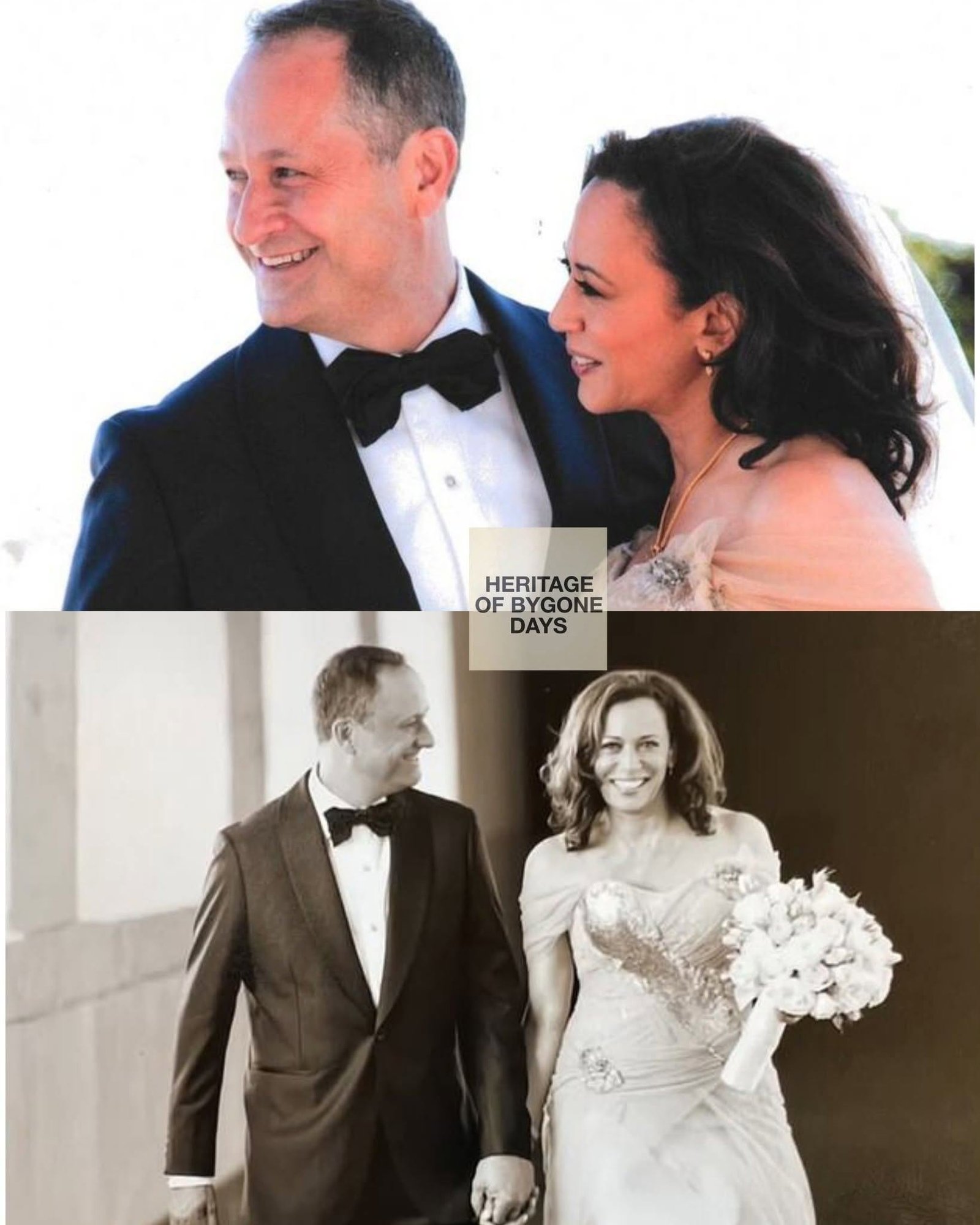
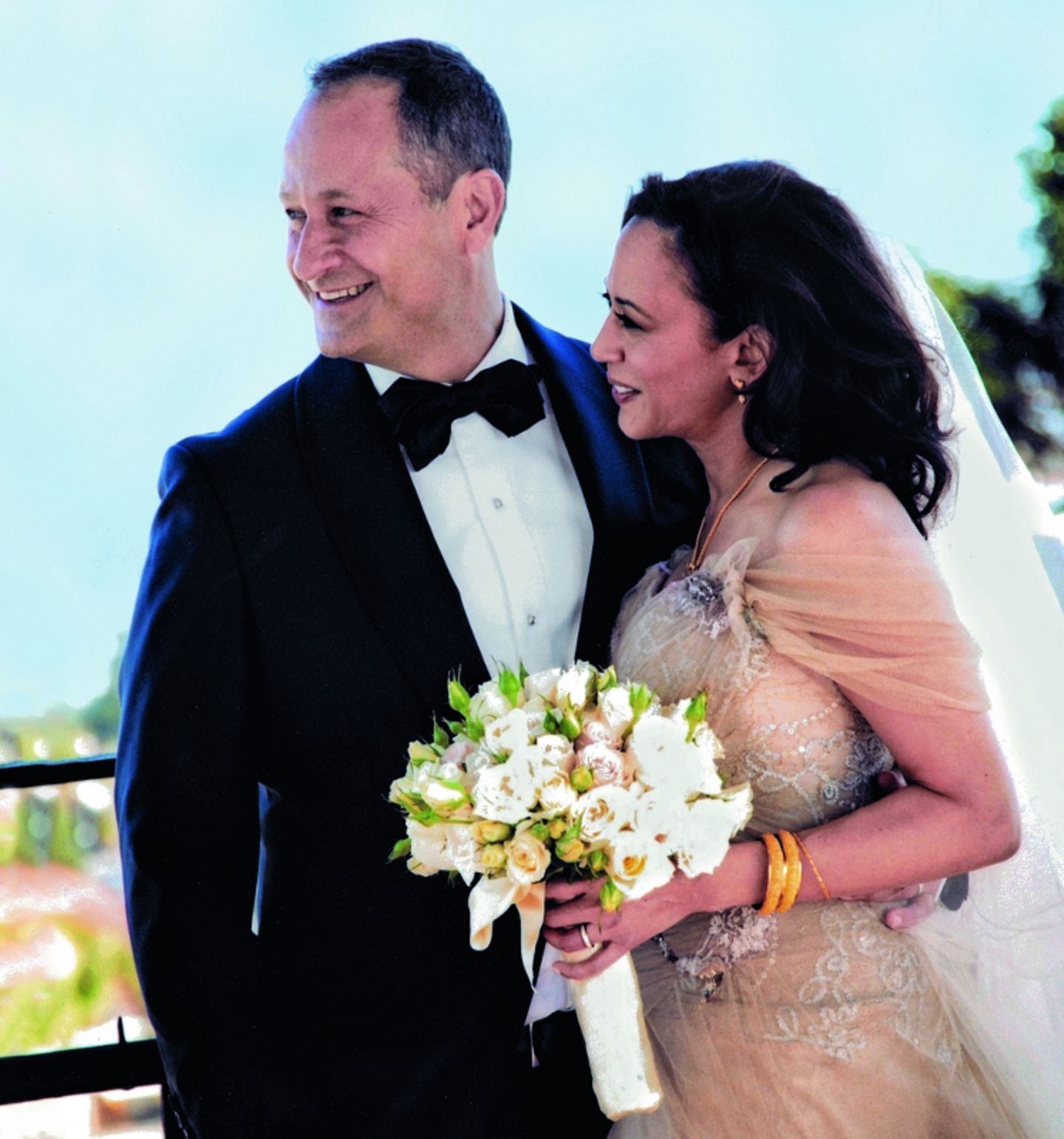
On a warm August day in 2014, inside the sunlit Mural Room of the Santa Barbara County Courthouse, Kamala Harris and Doug Emhoff stood before family and friends and made a promise that would quietly reshape both of their lives.
It was not a spectacle. It was not designed for headlines.
There were no sweeping displays of political symbolism, no grand orchestration meant for public consumption. Instead, there was something far more intimate—something that often escapes the frame of public life entirely:
Two people choosing each other, fully aware of the complicated lives they already led.
For Kamala Harris, then a rising figure in American politics and law enforcement leadership, the moment marked a rare pause in a career defined by urgency and responsibility. For Doug Emhoff, a successful entertainment lawyer with his own established life and family, it was the beginning of a partnership that would require not just romance—but reinvention.
And yet, what makes this story endure is not the wedding itself.
It is everything that nearly prevented it from ever happening at all.
Before the ceremony: a story that almost never began
Long before the courthouse vows, before the rings and photographs and family gatherings, there was a setup.
A mutual friend had arranged a blind date in 2013. In a world governed by schedules, expectations, and professional obligations, it was a simple act—almost casual in its intention.
But simple beginnings often carry the weight of unpredictable outcomes.
Doug Emhoff, aware of the significance of first impressions, did what many people do when nerves collide with anticipation: he tried too hard to get it right.
On the morning before the date, he placed a call to Kamala Harris. The intent was harmless—perhaps even charming. A brief introduction. A confident tone. A way to smooth the edges of uncertainty.
But the call did not go as planned.
It went to voicemail.
And what followed, according to accounts shared over the years, was a moment of unscripted vulnerability.
Doug spoke into the void of the recording system, improvising his introduction, stumbling through phrasing, circling around sentences, trying to sound composed while slowly realizing he was doing anything but.
It was, by his own later admission, not his finest moment.
Most people would have tried to forget it.
But sometimes, the things we wish to erase become the very things that define how we are remembered.

The voicemail that changed the tone of everything
When Kamala Harris listened to the message, something unexpected happened.
She did not dismiss it.
She did not interpret it as awkwardness or incompetence.
Instead, she reportedly found something disarming in it—something real.
In a world where people often present polished versions of themselves, the voicemail stood out precisely because it was unpolished. It was human. It was unguarded.
And in that moment, a small but significant shift occurred.
The blind date was no longer just a scheduled meeting between two professionals.
It became something else entirely:
a possibility.
Over time, the story of that voicemail would take on almost mythic qualities within their relationship. Friends and family would hear it referenced as an inside joke—a reminder that sometimes the things we fear are mistakes can become the very foundation of connection.
Not because imperfection is inherently romantic, but because authenticity, when recognized, can be profoundly rare.
The first meeting: where hesitation meets curiosity
When they finally met in person, the narrative could have gone in any number of directions.
Two ambitious individuals, both deeply embedded in demanding careers, both accustomed to navigating high-pressure environments, both carrying the weight of previous experiences.
There are relationships that begin with certainty.
And then there are relationships that begin with curiosity.
This was the latter.
The conversation, as later recounted in various profiles and interviews, flowed with unexpected ease. Humor surfaced naturally. Questions turned into stories. Stories turned into laughter.
And beneath it all, something subtle but important took root:
mutual recognition.
Not of status.
Not of ambition.
But of character.
A year of becoming something more
Their relationship developed not as a sudden blaze, but as a steady unfolding.
Both were deeply aware of the demands of their respective lives. Both understood that modern relationships—especially those lived under public scrutiny—require negotiation between personal desire and professional obligation.
And yet, over the course of roughly a year, something stabilized between them.
Trust.
Consistency.
A shared understanding that life was not going to slow down, and that love, if it was to survive, would need to move alongside it.
It is often said that the strength of a relationship is not measured in grand gestures, but in ordinary days.
Phone calls between meetings.
Quiet dinners after long work hours.
Support during moments of exhaustion that no public image ever captures.
This was the unseen architecture of their connection.
The proposal: simplicity in a complicated world
In March 2014, in Kamala Harris’s apartment, Doug Emhoff proposed.
There was no elaborate public display. No orchestrated spectacle designed for outside approval.
Instead, there was a ring—a simple round diamond—and a direct question asked in private space.
In relationships shaped by demanding careers, simplicity is not absence of meaning. It is often its deepest form.
Kamala Harris, known for decisiveness in both professional and personal contexts, accepted.
And with that decision, the trajectory of both their lives shifted irreversibly.
A short engagement and a clear conviction
Some couples spend years planning weddings. Others delay, reconsider, revise timelines repeatedly as life circumstances shift around them.
But Kamala Harris reportedly made clear from the beginning that she did not believe in prolonged engagements.
It was not impatience.
It was clarity.
And so, the engagement period remained brief—approximately five months—leading directly into the August ceremony in Santa Barbara.
In a world where delay is often mistaken for deliberation, their timeline reflected something different:
certainty.
The wedding: elegance without excess
The ceremony took place in the historic Mural Room of the Santa Barbara County Courthouse, a space known for its architectural beauty rather than its extravagance.
It was not a wedding designed to overwhelm.
It was designed to reflect identity.
Family and close friends gathered. The atmosphere was warm, intentional, and deeply personal.
Kamala Harris’s younger sister, Maya Harris, officiated the ceremony—an act that reinforced the central theme of the day: that this was not just a union of two individuals, but a merging of families, histories, and cultures.
Elements from both backgrounds were woven into the ceremony with care.
A flower garland honoring Kamala Harris’s Indian heritage.
A traditional glass-breaking ritual reflecting Doug Emhoff’s Jewish background.
These were not symbolic decorations added for aesthetic appeal.
They were acknowledgments of lineage.
Of continuity.
Of belonging.

Becoming a family: the moment names begin to matter
Perhaps one of the most quietly powerful aspects of this story did not happen during the ceremony at all.
It happened afterward.
Doug Emhoff had two children from a previous marriage, Cole and Ella. Blended families often navigate complex emotional terrain, shaped by adjustment, uncertainty, and evolving roles.
But something remarkable occurred in the years that followed.
The children chose their own name for Kamala Harris.
Not stepmother.
But “Momala.”
It is a word that carries affection, humor, and intimacy all at once.
And in many ways, it captures what official titles never fully can.
Because family is not defined only by structure.
It is defined by recognition.
By acceptance.
By the quiet decision to belong to one another.
What the world sees—and what it misses
Public narratives often reduce relationships involving political figures into simplified versions of themselves.
They become anecdotes, headlines, or symbolic footnotes in larger careers.
But behind those simplifications lies something far more complex:
a daily practice of partnership.
A negotiation between visibility and privacy.
Between public responsibility and private care.
Between the expectations of the world and the needs of the home.
The story of Kamala Harris and Doug Emhoff is not exceptional because it is perfect.
It is compelling because it is human.
:max_bytes(150000):strip_icc():focal(673x319:675x321)/kamala-harris-10-2000-6ebc9b1b2fdf44c696f1ad9e2835ca5a.jpg)
The hidden lesson inside an imperfect beginning
If there is a single thread running through their story, it may be this:
that awkward beginnings are not disqualifications.
They are invitations.
The voicemail that might have been forgotten.
The nervous introduction that felt clumsy.
The blind date that could have ended in indifference.
Each of these moments carried the potential for dismissal.
And yet none of them defined the outcome.
Instead, they became part of a larger narrative about attention—about choosing to see beyond surface discomfort and recognize something more enduring underneath.
Love in the context of public life
There is a misconception that public figures experience love differently—that visibility transforms intimacy into performance.
But if anything, it may be the opposite.
Public life intensifies the need for private grounding.
For a space where identity is not negotiated in headlines.
For relationships that exist not as statements, but as refuge.
In this sense, their marriage is not simply a personal milestone.
It is a reminder that even those in the most visible positions still seek the same fundamental human experiences as everyone else:
to be understood, to be supported, and to be chosen.
The enduring image: not grandeur, but recognition
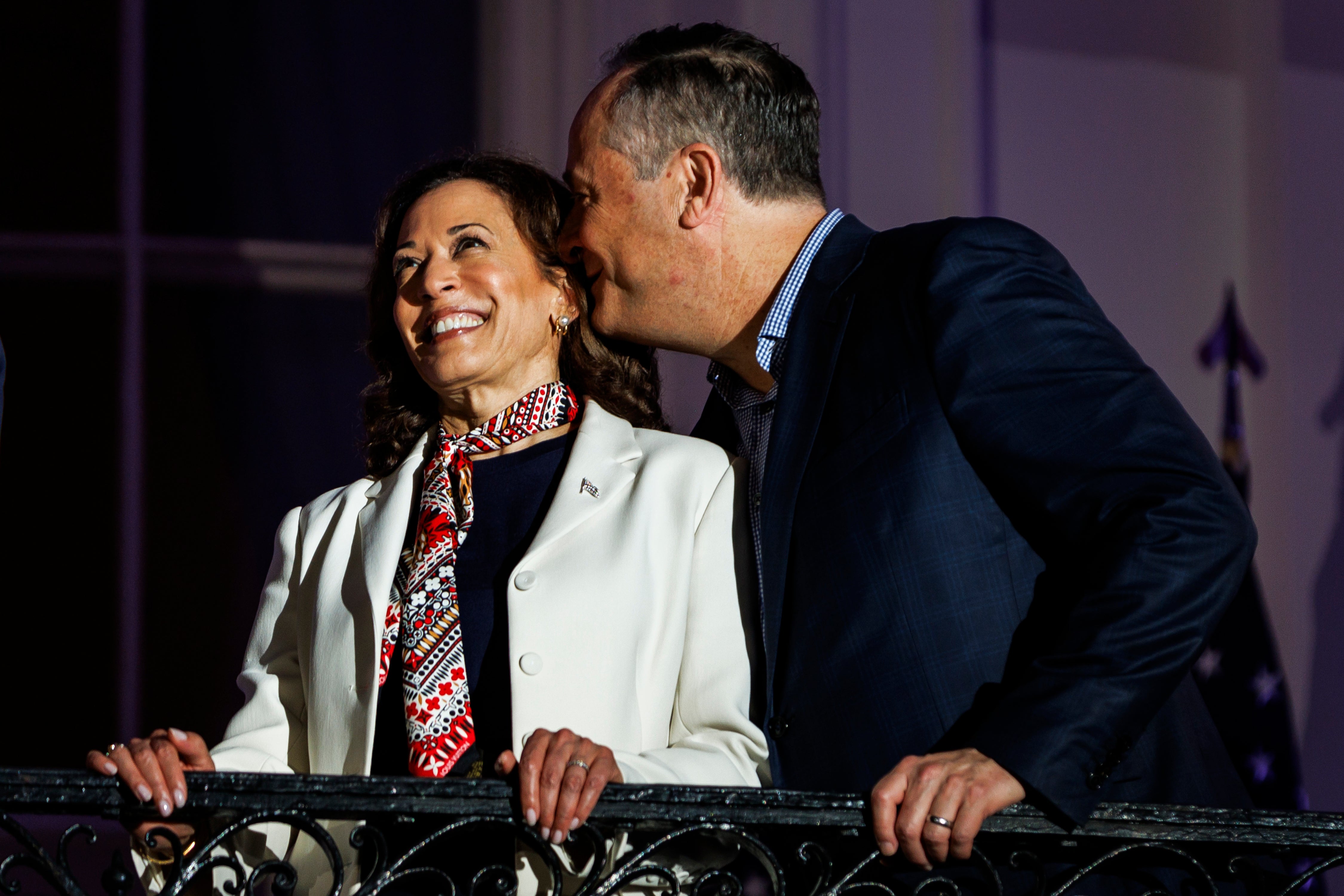
Years later, what remains most resonant about their wedding is not the ceremony itself, but the tone of it.
There is no overwhelming spectacle in the memory of that day.
Instead, there is something quieter:
a courthouse filled with light,
a family gathered in close proximity,
and two people stepping into a shared future with awareness rather than illusion.
A final reflection: what stories like this are really about
At its surface, this is a story about a marriage.
But at a deeper level, it is a story about attention.
About what we choose to notice in others.
About how quickly we dismiss imperfection.
And about the unexpected ways connection can emerge when we allow room for it.
The voicemail, the blind date, the short engagement—these are not just details.
They are reminders that life rarely unfolds in clean lines.
It stumbles.
It hesitates.
It improvises.
And sometimes, in those imperfect moments, something lasting begins.
Closing thought
If there is a lesson to take from the early days of Kamala Harris and Doug Emhoff’s relationship, it is not that love is effortless or inevitable.
It is that recognition matters.
The recognition of humor in awkwardness.
The recognition of sincerity in imperfection.
The recognition that sometimes, what begins uncertainly can still become something steady.
And perhaps most importantly:
that the most meaningful stories are not the ones that begin perfectly—
but the ones that begin honestly.