PART 1 — THE WAY SHE LOOKED AT MY BABY
The first time my mother-in-law saw my newborn daughter, she didn’t smile.
She didn’t coo over her tiny fingers or whisper about how perfect she was. She didn’t even ask if she could hold her.
Instead, Gianna leaned over the bassinet and stared.
Not at Stella’s face.
At her hair.
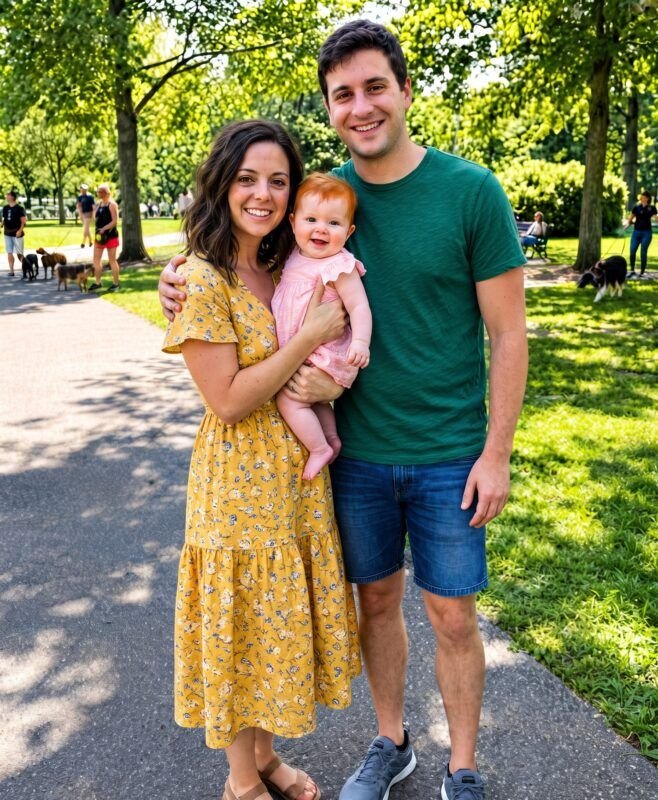
My daughter was only nine days old, and the soft fuzz covering her head was an unmistakable shade of copper red.
Bright. Warm. Almost glowing beneath the afternoon light.
The problem, at least in Gianna’s mind, was obvious.
My husband, Bryson, had dark brown hair.
So did I.
We both had brown eyes, while Stella’s newborn eyes were still a clear blue.
Gianna studied her for several uncomfortable seconds before finally glancing at me.
“Well,” she murmured, “that’s certainly noticeable.”
I was sitting on the couch with an ice pack pressed against my aching side, running on almost no sleep and whatever strength remained after giving birth.
Still, I heard the judgment in her voice.
“She’s beautiful,” I replied.
Bryson entered the room carrying two coffees and noticed his mother hovering over the bassinet like she was inspecting a suspicious package.
He laughed.
“Mom, she’s nine days old. Babies change.”
Gianna didn’t smile.
“Hair can darken,” she said. “Eyes can too.”
Then she looked down at Stella again.
“But some things don’t.”
Something about the way she said it made my stomach tighten.
At the time, though, I told myself I was exhausted.
Maybe I was imagining the implication.
I should have known better.
Gianna had spent most of my marriage mastering the art of saying cruel things in a tone polite enough that she could deny the cruelty later.
When Bryson and I bought our first house, she walked slowly through the living room before asking, “So this is what my son comes home to every day?”
When I left one job for another that offered better hours but less prestige, she smiled and said, “I suppose ambition means different things to different people.”
Every time, Bryson gave me the same explanation afterward.
“That’s just Mom, Macy.”
And for years, I allowed those four words to end the conversation.
I swallowed my irritation.
I let the little comments slide.
I convinced myself maintaining peace was more important than challenging every insult.
But after Stella was born, Gianna stopped hiding behind subtlety.
At two weeks old, Stella’s hair was still red.
At three weeks, Gianna finally held her.
She studied my daughter’s face for so long that I found myself watching her rather than enjoying the moment.
Then she said, “She doesn’t have Bryson’s eyes.”
I forced a small laugh.
“She’s three weeks old. Her eyes barely know what they’re supposed to be doing yet.”
Gianna handed Stella back to me.
“Bryson’s eyes were brown from the beginning.”
I said nothing.
By the fourth week, something else had changed.
Gianna stopped calling Stella her granddaughter.
It wasn’t dramatic enough for Bryson to notice immediately.
But I noticed.
Of course I did.
She would call and ask, “How’s the baby?”
Or she’d say, “Is Stella sleeping better?”
She never said, “How’s my granddaughter?”
Never called her “our little girl.”
Never spoke about the future the way excited grandmothers usually do.
It was as though she were deliberately placing distance between herself and my child.
I knew something ugly was building.
I just didn’t know how ugly it would become.
PART 2 — THE ACCUSATION
Stella was six weeks old when Gianna finally said the words she’d apparently been thinking since the day my daughter came home.
It was a Sunday afternoon.
I had just finished feeding Stella, and she was sleeping against my chest, one tiny fist curled beneath her chin.
Bryson sat at the coffee table folding a mountain of miniature onesies.
Gianna was across from us, unusually quiet.
She kept watching Stella.
Finally, she exhaled.
“I think we need to stop pretending.”
Bryson looked up.
“Pretending about what?”
Gianna nodded toward the baby in my arms.
“That nobody notices.”
I stared at her.
“Notices what?”
Her eyes settled on Stella again.
“That child looks nothing like my son.”
Bryson froze.
“Mom.”
But the warning in his voice wasn’t enough to stop her.
Gianna gestured toward Stella’s hair.
“Red hair. Blue eyes. Neither of you has either. Where exactly did those come from?”
My body went cold.
“Genetics don’t need your approval, Gianna.”
Her lips tightened.
And then she said it.
The sentence I would replay in my head for weeks afterward.
“I am not going to stand by while another man’s child is passed off as my son’s.”
The room went completely silent.
Even Stella seemed impossibly still against me.
Bryson whispered, “Mom, stop.”
But I wasn’t looking at Gianna anymore.
I was looking at my husband.
Because he wasn’t furious.
He wasn’t throwing his mother out.
He wasn’t defending me with the certainty I expected from the man who had held my hand while I gave birth to his daughter.
He looked uncomfortable.
Embarrassed.
Conflicted.
That frightened me more than Gianna’s accusation.
She leaned forward.
“If I’m wrong, then prove it.”
Bryson rubbed a hand across his face.
“Mom…”
“A DNA test,” she said. “That’s all.”
I nearly laughed.
Not because anything was funny.
Because sometimes disbelief comes out sounding like laughter.
“That’s all?” I repeated. “You’re accusing me of sleeping with another man and lying about my baby’s father.”
“If Stella is Bryson’s,” Gianna replied calmly, “then you have nothing to worry about.”
I turned to my husband.
“Bryson?”
He stared at the floor for a moment before finally meeting my eyes.
“Macy, I know this sounds terrible.”
“No,” I said quietly. “I don’t think you understand how terrible it sounds.”
He stood and moved closer.
“I love you.”
“That’s not what I asked.”
His eyes moved toward Stella.
Then back to me.
“Maybe if we just do the test, this whole thing can be over.”
My heart seemed to crack somewhere deep inside my chest.
“Over for whom?”
“For everyone.”
“I already know who Stella’s father is.”
“I know.”
My voice dropped.
“Do you?”
He hesitated.
Only for a second.
But a second was enough.
I stood carefully, holding my daughter against me.
“Fine.”
Bryson blinked.
“Macy—”
“We’ll do the DNA test.”
His face changed immediately.
“I don’t want you thinking that I—”
I stopped him.
“You wanted proof. You’ll have proof.”
Then I looked directly at Gianna.
“But once you get it, neither of you will be allowed to act as though what happened here was harmless.”
Gianna left not long afterward.
Bryson tried to talk to me that night.
I had nothing to say.
Because sometimes the deepest hurt doesn’t come from the person who accuses you.
It comes from the person you expected to defend you.

PART 3 — WAITING FOR A LABORATORY TO TELL MY HUSBAND THE TRUTH
The DNA test was scheduled two days later.
Cheek swabs.
Forms.
Signatures.
A bright, sterile room.
The technician spoke gently and professionally, as though families arrived there every day carrying the same invisible wound.
Maybe they did.
Stella slept through almost everything.
When we reached the parking lot afterward, Bryson tried to lighten the mood.
“At least Stella didn’t seem bothered.”
I clicked her car seat into place.
“Good for Stella.”
“Macy.”
I closed the door and walked toward the driver’s side.
He followed me.
“I didn’t accuse you.”
I stopped.
“You asked me to prove I wasn’t lying.”
“That’s different.”
“Not from where I’m standing.”
He dragged both hands down his face.
“I was scared.”
The words irritated me more than I expected.
“So was I.”
“Scared of what?”
I looked directly at him.
“Scared of discovering that the man I married could be convinced to doubt me because one person who has never liked me whispered the right suspicion in his ear.”
He had no answer.
The days that followed were strange.
Bryson became almost painfully attentive.
He washed every bottle.
Cooked dinner.
Did laundry without being asked.
When Stella woke at four in the morning, he got out of bed before I could move.
He held her.
Changed her.
Rocked her back to sleep.
Ordinarily, those things would have made me feel loved.
Instead, every kind gesture seemed to sit beside one fact neither of us could escape:
My husband was waiting for a laboratory report to confirm whether his wife had been faithful.
Eventually, the envelope arrived.
I placed it unopened on the kitchen counter.
Twenty minutes later, Bryson came home.
He saw it the moment he walked into the kitchen.
“Macy?”
I was sitting in the living room feeding Stella.
“It’s on the counter.”
He picked it up.
“You didn’t open it?”
“No.”
“Why not?”
I looked down at our daughter.
“Because I don’t need a test to tell me who her father is.”
Bryson stood silently for several seconds.
Then I heard the envelope tear.
Paper unfolded.
Silence.
More silence.
I could suddenly hear every tiny sound in the house.
The hum of the refrigerator.
Stella swallowing.
A truck rolling down the street.
The faint rustle of paper from the kitchen.
Then Bryson whispered,
“I can’t believe this is real.”
Something in his voice made me look up.
He read the page again.
Then again.
Finally, he walked toward me and turned it around.
PATERNITY PROBABILITY: GREATER THAN 99.99%.
I looked at the number.
Then at him.
“Congratulations.”
His eyes filled instantly.
“Macy…”
“Now you know.”
“I am so sorry.”
I adjusted Stella’s blanket.
“Don’t.”
He crouched beside me.
“I never should have listened to my mother.”
“No. You shouldn’t have.”
“I knew you would never betray me.”
I looked up sharply.
“Don’t change the story now, Bryson. If you knew, we wouldn’t have that piece of paper.”
He went quiet.
The report remained on the table between us, a piece of scientific proof I had never needed.
Then his phone rang.
Gianna.
He looked at the screen.
Then at me.
I said nothing.
He answered.
“Mom.”
Her voice was faint, but I could hear enough.
“Did the results come?”
Bryson shut his eyes.
“Yes.”
A pause.
Then he said firmly, “Stella is mine.”
Silence.
“Do you understand me?” he continued. “She is my daughter.”
Gianna said something I couldn’t make out.
Bryson’s jaw tightened.
“No. You’re done.”
Another silence.
Then Gianna murmured something.
Bryson suddenly went still.
“What did you say?”
No answer.
“Mom?”
Her voice became clearer.
“I said… then it came back.”
Bryson frowned.
“What came back?”
I shifted Stella higher against my chest.
Gianna said something else.
Bryson looked at me.
And this time, the expression on his face had nothing to do with paternity.
It was confusion.
Shock.
Maybe even fear.
Then the call disconnected.
“What happened?” I asked.
Bryson stared at the phone.
“She said, ‘Then it came back.’”
“What came back?”
His eyes moved toward Stella’s bright red hair.
Then he grabbed his keys.
“I don’t know.”
He headed toward the door.
“But I’m going to find out.”
PART 4 — THE PHOTOGRAPH THAT CHANGED EVERYTHING
Bryson drove.
I sat in the back seat beside Stella.
When Gianna opened her front door, Bryson didn’t bother with a greeting.
“What did you mean?”
She frowned.
“Mean about what?”
“‘Then it came back.’ What came back, Mom?”
Gianna glanced at me.
Then at Stella.
“I don’t know what you’re talking about.”
Bryson held up the DNA results.
“You reacted like you already knew red hair existed somewhere in our family.”
“Bryson—”
“Was it Dad?”
The color drained from her face.
That was all the answer he needed.
Bryson walked past her into the living room.
Family photographs covered one wall.
I had seen most of them before.
His father at their wedding.
His father holding Bryson as a baby.
His father beside a Christmas tree.
His father grilling in the backyard.
In every photograph I’d ever seen, he had dark hair.
“Where are the old albums?” Bryson asked.
Gianna’s voice became small.
“Please don’t do this.”
“Where are they?”
Ten minutes later, we were upstairs.
A dusty photo album lay open across Gianna’s bed.
Bryson turned page after page.
Childhood pictures.
School dances.
Birthday parties.
Then his hand stopped.
The boy in the photograph looked about seventeen.
He had freckles scattered across his face.
And even though the picture had faded with age, there was no mistaking his hair.
Copper red.
Almost exactly like Stella’s.
Bryson stared.
“Dad?”
Gianna slowly sat on the edge of the bed.
“Yes.”
Bryson looked from the photograph to our daughter.
Then back to his mother.
“You knew my father had red hair.”
Gianna didn’t respond.
“You accused my wife of cheating when you knew red hair existed in my own family?”
“It’s complicated.”
Bryson gave a short, bitter laugh.
“It really doesn’t look complicated.”
She pressed her hands together.
“Your father’s hair darkened when he got older.”
“That isn’t what I’m asking.”
For a long time, nobody spoke.
Finally, Gianna stood.
“There’s someplace I need to show you.”

PART 5 — THE SECRET WAS NEVER ABOUT STELLA
The old high school was about fifteen minutes away.
Gianna led us around the side of the building until we reached a quiet courtyard.
Several weathered benches sat beneath old trees.
She stopped beside one of them.
“Your father used to sit here.”
Bryson looked around.
“Why?”
Gianna stared at the bench.
“Because people were cruel to him.”
Then she looked at Stella.
“They teased him about his freckles. His hair. They came up with nicknames. They laughed whenever he walked past.”
Bryson’s expression hardened.
“And what did you do?”
Gianna didn’t answer.
Something passed over his face.
Realization.
“You were one of them.”
Her eyes filled.
“I was sixteen.”
“That isn’t an answer.”
“I wanted certain people to like me. I wanted to fit in.”
Bryson waited.
Gianna swallowed.
“Sometimes I laughed.”
Her voice broke.
“And sometimes…”
“Sometimes what?”
“I started the joke.”
No one spoke for several seconds.
Even the courtyard seemed unusually quiet.
Finally, Bryson asked, “How did Dad ever end up marrying you?”
Gianna wiped at her eyes.
Years after high school, she explained, they had unexpectedly run into each other at a neighborhood diner.
By then, she had grown up enough to understand what she’d done.
She apologized.
His father remembered every cruel word.
Every laugh.
Every day he had sat alone in that courtyard.
He did not forgive her immediately.
And Gianna did not expect him to.
They talked.
Then talked again.
Eventually, a cautious friendship formed.
Over time, friendship became something deeper.
“I loved your father more than I’ve ever loved anyone,” Gianna said.
Her voice shook.
“And I hated the girl I had been to him.”
Bryson held up the old photograph.
“So what does any of that have to do with Stella?”
Gianna looked toward my sleeping daughter.
“Because when I saw her hair, I saw him.”
Bryson stared at her.
“So you knew it was possible.”
“I knew that color had existed in the family, yes.”
“Then why accuse Macy?”
Gianna’s face crumpled.
“Because I hadn’t seen that shade of red since your father was young. And suddenly it was right in front of me again.”
Bryson’s voice was quiet.
“You didn’t hate Dad’s hair.”
“No!”
She looked horrified.
“I loved everything about him.”
“Then why did you hate it on Stella?”
Gianna lowered her eyes.
“Because seeing it brought back everything I hated about myself.”
I had been silent until then.
But I couldn’t stay silent anymore.
“So instead of dealing with your guilt, you decided my daughter didn’t belong to your family.”
Gianna flinched.
“I wasn’t thinking clearly.”
“You thought clearly enough to accuse me of cheating.”
“I know.”
“You thought clearly enough to stop calling Stella your granddaughter.”
Her shoulders sagged.
“I know.”
Her confession didn’t erase anything.
If anything, it made the accusation more painful.
Gianna hadn’t suspected me because the evidence was overwhelming.
She had known all along that Stella’s red hair could have come from Bryson’s side.
She had simply allowed an old wound to become an excuse to hurt someone else.
When we reached the parking lot, she hurried after me.
“Macy, please.”
I opened the car door.
“I’m sorry.”
I turned toward her.
“Don’t apologize to me first.”
She blinked.
I looked down at Stella.
“For weeks, you treated her as though she didn’t belong here. You wouldn’t even call her your granddaughter.”
Gianna’s eyes filled again.
“So start with her.”
Then I got into the car.
Bryson climbed behind the wheel.
Halfway home, he reached toward my hand.
I moved it into my lap.
He withdrew his.
“I was scared,” he said quietly.
“So was I.”
He looked at me.
I continued.
“I had just become a mother. I was exhausted, vulnerable, terrified of doing everything wrong. And the person who was supposed to make me feel safest decided his mother’s suspicion deserved more respect than my word.”
He stared at the road.
“But now we know the truth.”
I turned toward him.
“You know the truth now.”
He flinched.
“I always knew it. I didn’t need a laboratory to tell me who I slept with.”
He didn’t argue.
For once, he understood that there was nothing he could say to make the hurt disappear faster.
PART 6 — NOBODY IS HIDING HER
That evening, our doorbell rang.
Gianna stood outside.
For perhaps the first time since I’d known her, she didn’t simply walk into our house.
“May I come in?”
I stepped aside.
Stella was awake in her bassinet.
Gianna approached slowly but didn’t reach for her.
Instead, she looked at me.
“May I hold my granddaughter?”
The word seemed to hang in the room.
My granddaughter.
I studied Gianna for a moment.
Then I lifted Stella and carefully placed her in her grandmother’s arms.
Gianna looked down at the tiny copper-colored tuft sticking straight upward from Stella’s head.
A surprised little sound escaped her.
“Oh.”
Bryson looked over.
“What?”
Gianna gave a trembling smile.
“Your father’s hair used to do that.”
Bryson stared at Stella.
Gianna laughed softly through her tears.
“He’d flatten it every morning before school. He’d use water, a comb, anything he could find.”
She gently touched Stella’s tiny hand.
“And by lunchtime, it would be sticking straight up again.”
For the first time, the red hair wasn’t being discussed like evidence.
It was a memory.
A connection.
A piece of someone Stella would never meet but would carry with her anyway.
Then Gianna surprised us.
“There’s something else I want to show you.”
We followed her back to her house.
She went upstairs and opened an old cedar chest.
After moving several folded blankets, she pulled out a small knitted cap.
“His mother made this for him,” she explained.
Bryson touched the faded fabric.
“Why?”
Gianna hesitated.
“Because the teasing became so bad that he wanted to hide his hair.”
Bryson’s expression changed.
“He actually wore this?”
She nodded.
Then she looked at Stella.
Almost instinctively, Gianna lifted the cap toward our daughter’s head.
Her hands stopped halfway.
Nobody spoke.
She looked at the cap.
Then at Stella’s bright copper hair.
Something shifted in her expression.
Slowly, she lowered the cap.
Folded it.
Placed it back inside the cedar chest.
Then she shut the lid.
“No.”
Bryson frowned.
“No what?”
Gianna looked at her granddaughter.
“Nobody is hiding her.”
I felt something tighten in my throat.
It didn’t erase the accusation.
It didn’t repair my marriage.
It didn’t suddenly make Gianna’s behavior acceptable.
But it was a beginning.
Not forgiveness.
Not yet.
A beginning.
Later that night, Stella slept against my chest while I sat on the couch.
Bryson sat at the opposite end.
He didn’t move closer.
Didn’t reach for my hand.
Didn’t tell me I needed to forgive him because the results had proved everything was fine.
After a long silence, he said,
“Macy?”
I looked at him.
He started to speak.
Stopped.
Then asked something much more important.
“What do you need from me?”
I didn’t have to think.
“Time.”
Bryson nodded.
“Okay.”
And for once, he didn’t bargain with my answer.
He didn’t ask how much time.
Didn’t tell me I was being unfair.
Didn’t remind me that he had apologized.
He simply let my answer stand.
Stella shifted in her sleep.
The little red tuft on top of her head sprang upright again.
Bryson noticed it.
A sad smile crossed his face.
“Dad’s hair.”
I looked down at my daughter.
Only days earlier, people had looked at that same hair as proof that she belonged somewhere else.
It had been questioned.
Judged.
Used as an excuse to accuse her mother.
Now we knew differently.
That bright copper hair wasn’t evidence that Stella didn’t belong to our family.
It was proof that families sometimes carry pieces of the past for generations.
A smile.
A gesture.
A stubborn strand of hair.
Even memories nobody talks about.
But perhaps the most important thing we learned had nothing to do with genetics.
Gianna had spent years carrying shame about the way she treated a red-haired boy when she was sixteen.
Instead of facing that shame, she had allowed it to hurt another person.
Bryson had allowed fear to matter more than trust.
And I learned that loving someone doesn’t require pretending they haven’t wounded you.
Love can include boundaries.
Forgiveness can take time.
And an apology doesn’t automatically erase the consequences of what happened before it.
Stella slept peacefully against me, unaware that her six-week-old head of red hair had dragged an old family secret into the light.
Nobody reached over to flatten it.
Nobody suggested covering it.
Nobody questioned where it came from.
That stubborn little tuft stood straight up while she slept.
Exactly where it belonged.
Note: This story is a work of fiction inspired by real events. Names, characters, and details have been altered. Any resemblance is coincidental. The author and publisher disclaim accuracy, liability, and responsibility for interpretations or reliance. All images are for illustration purposes only.