I counted the calls because the digital clock on the sterile white wall sat directly across from my bed.
Nine.
Nine times my thumb trembled against the cracked screen of my phone, the plastic casing stained with a smear of my own dried blood. Nine times I listened to the hollow ringing. Nine times I called my mother, then my father, then the family group chat. Nine times I got the same responses: voicemail, silence, and one automated text reply from my mother that read, “We’re at Lauren’s. Is this urgent?”
I stared at the word urgent while the heart monitor beside me mapped the erratic, terrified rhythm of my chest.
Twenty-four hours earlier, a commercial delivery truck had blown through a red light on 5th Avenue and broadsided my sedan. The memory was a fragmented nightmare of shattering glass, the crushing weight of metal folding inward, and the metallic taste of copper filling my mouth. My injuries were severe—a ruptured spleen, three cracked ribs, and severe internal bleeding.
But the physical trauma was nothing compared to the cold, clinical truth the night nurse, Marisol, had just handed me.
Marisol adjusted the IV drip in my bruised arm, her eyes avoiding mine. She was a veteran trauma nurse, a woman who had seen the worst of human fragility, yet she looked profoundly uncomfortable.
“Marisol,” I rasped, my throat raw from the intubation tube they had removed hours ago. “Tell me exactly what she said. Word for word.”
Marisol sighed, her hands pausing on the plastic tubing. “Miranda, you need to keep your heart rate down. We barely stabilized you.”
“Tell me,” I demanded, a cold sweat breaking out across my forehead.
“You are O-negative. The universal donor, but you can only receive O-negative,” Marisol said quietly, finally looking at me. “When you arrived, our reserve was critically low due to a multi-car pileup earlier in the day. We needed a direct donor match, immediately. I found your emergency contact file. I called your mother at 11:18 AM. I told her you were in critical condition, bleeding internally, and that we needed her or your father here right away to donate blood to save your life.”
A sickening knot formed in my stomach. “And?”
“And she sighed,” Marisol said, her professional tone hardening with thinly veiled disgust. “She said, ‘Listen, I’m sure it’s just a scrape. She’s always exaggerating. We are right in the middle of moving the heavy furniture into Lauren’s new house in Ridgefield. We can’t just drop everything. Use whatever blood you have in the fridge. We’ll swing by this evening.’ Then she hung up.”
The room spun. The rhythmic beep of the monitor seemed to echo from underwater.
They didn’t just miss a call. They knew I was dying. They knew I needed their blood—the literal blood in their veins—to survive. And they chose a suburban living room setup over my life. If the hospital hadn’t managed to source a transport of O-negative from a neighboring county clinic thirty minutes later, I would be a corpse on a steel table right now.
I looked down at my phone. Nine calls. I hadn’t been calling to beg for comfort. I had been calling to see if it was a mistake. If maybe the connection was bad. If maybe Marisol had misunderstood.
But the text stared back at me. Is this urgent?
A strange, absolute clarity washed over me. It was as if the accident had violently shaken me awake, not just from sleep, but from a thirty-year illusion.
I pressed the call button.
“Marisol,” I said, my voice no longer shaking. “Can you reach into my purse in the closet? I need the business card for Julian Vance. And I need you to dial it for me.”
By 8:15 PM, my estate attorney, Julian, stood at the foot of my hospital bed. He wore a sharp charcoal suit, entirely out of place in the sterile ICU bay. He had represented me since I sold my medical software company for a life-changing sum two years earlier. My parents knew I was wealthy. They did not know I was an eight-figure woman. And more importantly, they didn’t know they were the primary beneficiaries of my trust.
“Miranda,” Julian said, his sharp eyes scanning my bruised face. “I came as soon as you called, but you look like you should be resting, not drafting legal addendums.”
“I don’t want an addendum, Julian,” I breathed, fighting the searing pain in my ribs. “I want a complete revocation. I want them out of the will. I want the medical proxy changed. I want their access to the emergency accounts terminated. Now.”
Julian didn’t argue. He unlatched his leather briefcase, the click sounding incredibly loud in the quiet room. “I brought the standard revocation forms just in case. But Miranda… there is something else you need to know. Something I discovered an hour ago when I pulled your file.”
He pulled out a tablet and tapped the screen, his jaw set in a grim line.
“What is it?” I asked, a new wave of dread washing over me.
Julian looked up, his eyes dark with professional fury. “Your parents didn’t just ignore the hospital’s call today. At 1:30 PM—while you were in the middle of emergency surgery, while your heart rate was crashing—your father walked into a Chase branch in Ridgefield.”
Julian turned the tablet toward me. It displayed a frozen wire transfer request.
“He used the old, general Power of Attorney you signed five years ago before your company took off,” Julian said softly. “He attempted to initiate a wire transfer of five hundred thousand dollars from your primary investment account directly into an escrow account under your sister Lauren’s name.”
The breath left my lungs.
“He thought you were going to die on that table today, Miranda,” Julian whispered. “And instead of rushing here, he tried to loot your estate before it could go to probate.”
My vision blurred, the edges of the hospital room turning a hazy, nauseating gray. I felt the monitors beside me accelerate, the high-pitched alarms warning the nurses’ station of my spiking heart rate.
“Miranda, breathe,” Julian commanded, his voice slicing through my panic. He poured a small cup of water and guided the straw to my cracked lips. “Breathe. The money is safe. I flagged the transfer as suspicious and placed a hard freeze on the account pending your verbal confirmation. The wire did not go through.”
I swallowed the tepid water, coughing weakly as the movement pulled at the stitches in my abdomen.
“He… he tried to steal half a million dollars?” I choked out, the words tasting like ash. “While I was bleeding?”
“He categorized it as an ‘early inheritance distribution’ authorized by the POA,” Julian explained, his tone laced with legal disgust. “It’s a blatant abuse of fiduciary duty. He assumed that if you didn’t survive the surgery, the transfer would be processed before the death certificate was officially filed, effectively hiding the money from estate taxes and guaranteeing Lauren got it instantly.”
The sheer, calculated predatory nature of it paralyzed me.
My mother had refused to give me her blood. My father had tried to take my life’s work. And they did it all on a Tuesday afternoon while unpacking throw pillows for my golden-child sister.
“Give me the pen,” I said.
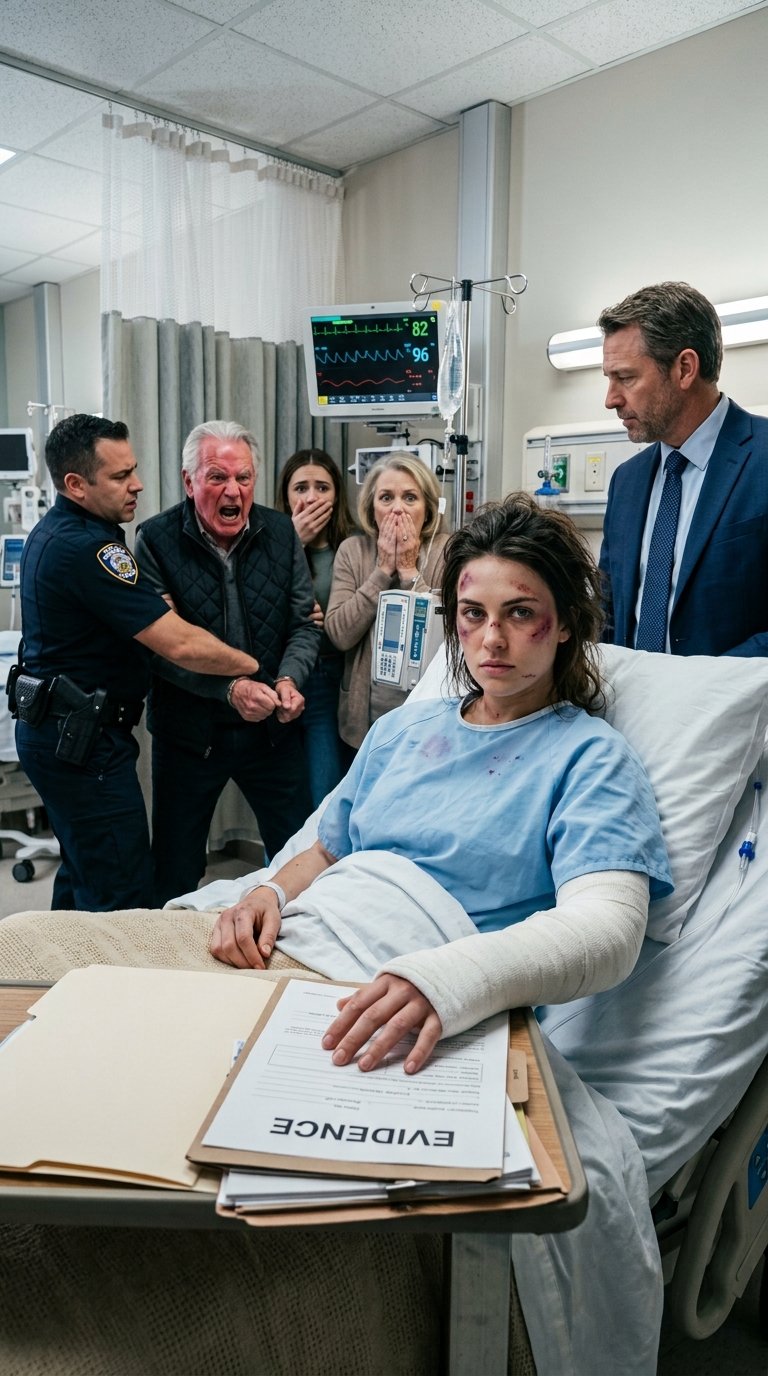
My hand shook uncontrollably as Julian laid the thick stack of documents on the rolling tray table.
“This first document revokes the old Power of Attorney,” Julian guided, pointing to the signature line. “This second document removes them entirely from your living trust. Lauren is removed. The lake house on Winnipesaukee, which you’ve been secretly paying the mortgage on, reverts to your sole control. The retirement care plans are dissolved.”
I signed my name. Once. Twice. Three times. The ink felt like a blade severing the infected, rotting ties to the people who had brought me into this world only to bleed me dry.
“Marisol,” Julian called out. The nurse stepped in immediately, an attending physician trailing behind her. “I need you both to witness that Ms. Caldwell is awake, oriented, aware of her assets, and signing these documents under her own free will.”
The doctor asked me today’s date, my name, and my location. I answered with a voice like cracked glass. They signed the witness lines.
“It’s done,” Julian said, sliding the papers back into his briefcase. “As of 8:42 PM, your family has absolutely no legal or financial authority over you, nor any claim to your estate.”
I sank back into the pillows, a hollow exhaustion settling into my bones. I had thought cutting them off would feel victorious. It didn’t. It felt like standing in the ruins of a burned-down house, realizing you were the only one who ever cared about the foundation.
Then, the heavy double doors of the ICU bay swung open.
“Excuse me, you cannot just walk in here!” a security guard’s voice echoed from the hallway.
“I am her mother!” a familiar, shrill voice snapped back. “I have medical proxy!”
My heart hammered against my ribs.
My father pushed through the doorway first. He was wearing his expensive golf polo, completely devoid of sweat or dust. My mother followed, her hair perfectly blown out, clutching a designer handbag. Lauren trailed behind them, scrolling on her phone, looking intensely bored by the medical equipment surrounding us.
They hadn’t rushed. They hadn’t cried. They looked exactly as they always did: inconvenienced by my existence.
My mother didn’t rush to my bedside. She didn’t look at the bandages wrapping my torso or the IVs snaking into my skin. She marched straight to the foot of the bed, her face flushed with indignation.
“Miranda!” she hissed, completely ignoring Julian standing in the corner shadows. “What is going on with your emergency credit card? Lauren was at Restoration Hardware trying to pay for the imported Italian sectional, and the card was declined! The manager humiliated us in front of the whole store!”
The silence in the room was absolute. Even the machines seemed to pause.
She wasn’t here because she feared I was dead. She was here because her shopping spree got interrupted.
I looked at my father. “Did you like the sofa, Dad? Was it worth five hundred thousand dollars?”
My father froze. His eyes darted to me, really looking at me for the first time. He noticed my steady gaze. He noticed I wasn’t groggy.
And then, he finally noticed the man in the navy suit standing by the window.
“What is he doing here?” my father demanded, the color draining from his face as he recognized Julian.
Julian stepped forward, the overhead fluorescent lights catching the cold glint in his eyes.
“I’m here,” Julian said smoothly, “to inform you that the credit card wasn’t just declined, Mr. Caldwell. It was seized. Just like the wire transfer you attempted to steal at 1:30 this afternoon.”
My father stopped breathing. Literally. His chest froze, and his hands dropped to his sides.
My mother, oblivious to the legal landmine her husband had just stepped on, turned her fury toward Julian. “Excuse me? Who do you think you are? We have a Power of Attorney! We are managing Miranda’s affairs while she is incapacitated!”
“I’m not incapacitated, Mom,” I said, my voice barely above a whisper, but in the dead silence of the ICU, it rang like a bell. “I’m missing a spleen. I have three broken ribs. I almost bled to death on an operating table today. But my brain works perfectly fine.”
Lauren finally looked up from her phone, sensing the shift in the room’s gravity. “Oh my God, Miranda, stop being so dramatic. We were busy. You know today was my move-in day. You’re fine. The doctors handled it.”
“The doctors handled it,” I repeated, tasting bile. I looked at my mother. “Marisol called you at 11:18 AM. She told you I needed O-negative blood immediately. You have O-negative blood. You told her to use the reserves because you couldn’t leave Lauren’s house.”
My mother’s face twitched. For a second, the mask slipped, revealing the ugly, selfish core I had spent my whole life pretending not to see. Then, she quickly rearranged her features into a mask of wounded motherhood.
“I… I didn’t understand the severity, Miranda,” she stammered, pressing a hand to her chest. “Nurses always exaggerate to get family members to rush over. I knew you were strong. I knew you’d pull through!”
“If they hadn’t found a donor in the next county, I would be dead,” I stated flatly.
“But you aren’t!” Lauren groaned, rolling her eyes. “Can we stop focusing on the negative? We came all the way down here. Now tell this lawyer guy to unfreeze the card. The delivery guys are coming tomorrow, and I need that sectional.”
“Shut up, Lauren,” my father hissed, his voice trembling. He hadn’t taken his eyes off Julian. He understood money, and he understood risk. He knew exactly what Julian’s presence meant.
“Mr. Caldwell,” Julian said, picking up his briefcase. “At 8:42 PM, my client executed a complete revocation of all prior estate documents. You are no longer her medical proxy. You are no longer her financial proxy. You have been removed as beneficiaries of the Caldwell Trust. The lake house on Winnipesaukee, which she legally owns, will be listed for sale next week. You have thirty days to vacate.”
My mother shrieked. It was a raw, guttural sound of pure financial terror. “The lake house?! You can’t do that! That’s where we’re retiring!”
“You’re retiring on my dime,” I said, the pain in my ribs igniting into a fierce, burning anger. “For seven years, I paid the mortgage you told me you couldn’t afford. But you could afford a down payment on a million-dollar Ridgefield home for Lauren, couldn’t you?”
Lauren blinked, stepping back. “Wait. Mom said she used Grandma’s matured bonds for my house.”
I almost laughed, but my chest wouldn’t let me. “There were no bonds, Lauren. There was just me. My savings. The money I earned building a company while you dropped out of grad school and crashed cars.”
Lauren turned to our parents, her face twisting. “You lied to me? You used her money for my house?”
“Don’t act like a victim, Lauren!” my father suddenly roared, the veins in his neck bulging. The pressure was cracking him open. “You knew exactly where the money was coming from! Who do you think told us to transfer the five hundred thousand today?!”
The room went dead still.
My mother gasped, covering her mouth.
I stared at my sister. The golden child. The one who could do no wrong.
Lauren’s face went completely white. “Dad, shut up!”
“No, let’s hear it,” I whispered, the adrenaline flooding my system, making me feel invincible despite the tubes in my arms. “Tell me, Dad.”
My father was cornered, sweating through his expensive shirt. “She called me at 1:00 PM,” he spat, pointing a shaking finger at Lauren. “After the hospital called again. She said… she said if your injuries were that bad, we needed to secure the assets before the estate went into probate. She said if you didn’t make it, the software company money should go to her trust immediately so it wouldn’t get tied up in court!”
The betrayal was so profound, so absolute, that it didn’t even hurt. It just severed the last remaining thread of my humanity that tied me to these people.
They hadn’t just ignored my dying. They had actively planned to profit from it. While a surgeon had his hands inside my chest, trying to staple my spleen back together, my family was arguing over how fast they could liquidate my life.
Lauren backed toward the door, shaking her head. “I didn’t mean it like that! I just… I wanted to make sure the family was protected!”
“The family,” I repeated. “You mean you.”
My mother rushed to my bedside, tears streaming down her face. This time, they were real. Because she realized the ATM was permanently closed.
“Miranda, please,” she sobbed, reaching for my hand. “We panicked! We were terrified! People make mistakes when they’re scared! You’re our daughter! We love you!”
I looked at the hand reaching for me. The hand that refused to roll up its sleeve and give me blood.
I didn’t pull away. I just looked at her with eyes as dead and cold as the pavement I had bled on.
“You don’t love me, Mom,” I said softly. “You love what I can buy you. But the store is closed.”
Julian cleared his throat. The sound was polite, but it carried the weight of an executioner’s axe.
“We aren’t just discussing a disinheritance, Mrs. Caldwell,” Julian said, opening a red folder he had kept hidden in his briefcase. “We are discussing federal crimes.”
The word crimes sucked the remaining oxygen out of the ICU.
My father stumbled backward, his knees hitting the plastic visitor’s chair with a loud, hollow thud. For a man who had spent his entire life commanding boardrooms and intimidating waiters, he suddenly looked as fragile as dry parchment.
“What… what are you talking about?” he stammered, the authoritative bass in his voice completely gone. “It was a family account! We share the same blood. It was a precaution!”
“It was an individual trust account, Mr. Caldwell,” Julian corrected, his voice devoid of a single drop of mercy. He didn’t raise his voice; he didn’t need to. The truth was heavy enough. “Using a Power of Attorney to transfer half a million dollars to a third party for personal enrichment while the principal is incapacitated is the textbook definition of Fiduciary Abuse. And because you attempted to execute this transfer electronically across state lines, it constitutes Federal Wire Fraud.”
My mother stopped crying. The theatrical tears dried up instantly, replaced by a pale, slack-jawed horror. She looked at Julian, her mouth opening and closing like a suffocating fish on a dock.
“The penalties for elder or dependent adult financial abuse—and given Ms. Caldwell’s critical medical state and ICU admission, she legally qualifies as a dependent adult in this context—include mandatory restitution, severe civil penalties, and up to twenty years in federal prison,” Julian stated, reading off a heavily watermarked document as casually as if he were reading a dinner menu. “I have already compiled the IP logs from the bank, the timestamps of your phone call with Lauren, and the medical records proving Miranda was under anesthesia at the exact moment you clicked ‘transfer’.”
Lauren grabbed the heavy metal handle of the hospital door, her eyes wild, scanning the room as if looking for a fire exit. “I didn’t sign anything! My name wasn’t on the transfer! I have nothing to do with this!”
“Lauren!” my mother screamed, betrayed by her own favorite child. Her voice cracked, echoing off the tile walls. “We did this for you! You needed the furniture! You said Connor would leave if the house wasn’t perfect!”
“I have a husband! I have a new house! I am not going to federal prison for you!” Lauren shrieked back.
She didn’t look at me once. She didn’t apologize for my broken ribs, for the blood I had lost, or for plotting to pick my bones clean while I was on an operating table. She just yanked the heavy door open and ran down the hallway. The frantic click-clack of her designer heels echoed like rapid gunshots, growing fainter and fainter until the silence swallowed her completely. She had abandoned them, just as easily as they had abandoned me.
My parents were left standing alone at the foot of my bed. Without Lauren there to act as the center of their universe, to justify their greed, they looked small, pathetic, and utterly terrified.
My father looked at me, his eyes wide with a desperation I had never seen before. The arrogant patriarch was gone, replaced by a cornered animal.
“Miranda… you wouldn’t,” he whispered, his hands shaking so violently he had to grip the edge of the rolling tray. “You wouldn’t send your own flesh and blood to a cell. It would ruin us. It would be in the papers.”
I looked at the heart monitor beside my bed. The glowing green line was finally steady. My pulse was calm. I had survived the crushing impact of the delivery truck. I was surviving them.
“I didn’t try to steal your money, Dad,” I said, my voice raspy but steady. “I didn’t refuse to give you blood when you were dying. I’m not sending you to prison. The law is. I’m just finally letting it.”
My mother collapsed. She literally fell to her knees on the sterile linoleum floor, her expensive handbag spilling its contents—lipstick, a compact mirror, the keys to the lake house—across the tiles. She grasped at the edge of my bed sheets, burying her face in the thin fabric.
“Please! Miranda, I’m begging you! I’ll do anything! We’ll sell the lake house for you! We’ll pay back every cent of the mortgage! Just please, don’t let him file those papers to the FBI!” she wailed, the mascara running down her face in dark, ugly rivers.
I stared down at her. A phantom pain flared in my chest, right where my ribs were strapped. When I was ten years old, I would have done anything for her to look at me with half this much desperation. When I was twenty, I would have moved mountains for her to beg for my presence.
But now, looking at her weeping on the floor, I felt absolutely nothing. The space inside me where a daughter’s love used to live had been completely, surgically cauterized.
“Marisol,” I called out without breaking eye contact with my father.
The nurse, who had been standing silently by the door like a guardian angel in scrubs, stepped forward immediately.
“Could you call hospital security?” I asked politely. “These people are trespassing. And I am very, very tired.”
My father tried to grab my mother’s arm to pull her up, his face a mask of utter, burning humiliation. “Come on, Helen. Get up. Have some dignity. We’re leaving.”
“No! Miranda, please! You’re my baby!” she screamed as two large security guards stepped into the room.
They didn’t have to use physical force, but their sheer size and presence were enough. They boxed my parents in, gently but firmly guiding my weeping mother and my broken, silent father out of the bay.
The heavy doors swung shut behind them. The click of the metal latch sounded like a heavy vault sealing permanently.
Julian quietly gathered his papers, snapping the locks on his leather briefcase. “I will file the fraud injunction first thing in the morning, Miranda. They won’t be able to touch a single cent of your money ever again.”
“Thank you, Julian,” I whispered, closing my eyes as a profound, heavy exhaustion finally dragged me under.
“Rest,” he said gently. “The war is over.”
One Year Later
Recovery was not a cinematic montage of triumphs. It was a grueling, agonizing march measured in inches.
It was spending Thanksgiving in a physical rehabilitation center, learning to breathe deeply without a searing pain tearing through my chest. It was spending Christmas morning signing the final, brutal settlement paperwork to dissolve the Caldwell Trust.
Julian’s threat of criminal charges had worked flawlessly. To avoid a highly publicized federal wire fraud trial that would have ended with them in jumpsuits, my parents agreed to sign a comprehensive, ironclad settlement. They surrendered all claims to the Winnipesaukee lake house, signed lifetime non-disclosure agreements, and accepted a permanent restraining order.
I heard through the grapevine of a distant cousin that Lauren’s picture-perfect suburban life imploded shortly after. Her husband, Connor, divorced her the moment he discovered the true source of their down payment and realized the “Caldwell fortune” was permanently locked away from them. Without my money to prop up her lifestyle, the Ridgefield house went into foreclosure.
My parents, stripped of the lake house and my secret mortgage payments, were forced to declare bankruptcy. They moved into a cramped, rented apartment on the outskirts of the city. They had sacrificed me for a guest room, and ended up with nothing.
The afternoon sun was pouring through the floor-to-ceiling windows of a high-rise boardroom overlooking the Boston skyline. I sat in a plush leather chair, wearing a tailored suit that hid the faint scars on my abdomen, holding a glass of sparkling water.
Across from me sat Dr. Elena Morris and Marisol, who was now officially a certified Nurse Practitioner, her tuition fully paid for by a scholarship I had quietly arranged. Julian sat to my right, reviewing a stack of pristine financial ledgers.
We were reviewing the first quarter grants for the newly established Caldwell Patient Recovery Foundation.
“The first block of funding has been distributed beautifully,” Elena smiled, tapping her tablet. “Fifty families of ICU trauma patients received fully paid hotel accommodations this month. Nobody had to choose between sleeping in their car or abandoning their loved ones. And the emergency O-negative blood donation drive we sponsored in your name? It broke state records.”
I smiled, a genuine, warm feeling spreading through my chest. It felt like breathing pure oxygen. The money that my family had tried to steal was now buying time, comfort, and actual survival for people who loved each other.
My phone vibrated silently on the glass table.
I glanced down. It was an unsaved number, but I recognized the area code immediately.
“Miranda, it’s Mom. Dad’s heart isn’t doing well. The doctors say it’s stress. We have nothing left. Please. I know we made terrible mistakes, but I miss my little girl. Family is forever. I’m begging you to call me back.”
I stared at the glowing words for a long moment. I felt a faint, phantom ache in my ribs, a permanent, physical reminder of the day I learned what family really meant to them.
For thirty years, a message like this would have sent me running. I would have paid the hospital bills. I would have apologized for making them feel bad about hurting me.
But I wasn’t that girl anymore. I had bled her out on an operating table a year ago.
I didn’t block the number. I didn’t reply to tell her how much she had destroyed me. I didn’t need the last word anymore.
I simply swiped the notification to the left, tapping ‘Delete’, and watched her words vanish into the digital void.
“Everything alright, Miranda?” Marisol asked, noticing my brief pause, her eyes filled with that same fierce, protective kindness she had shown me on the worst night of my life.
I looked up at the people in the room. My lawyer who protected my life’s work. The doctor who stitched me back together. The nurse who held my hand when my own mother wouldn’t. This was my family now. A family built on respect, not extortion.
“Yes,” I said, picking up my pen and pulling the next grant approval toward me. “Everything is exactly how it should be.”
If you want more stories like this, or if you’d like to share your thoughts about what you would have done in my situation, I’d love to hear from you. Your perspective helps these stories reach more people, so don’t be shy about commenting or sharing.