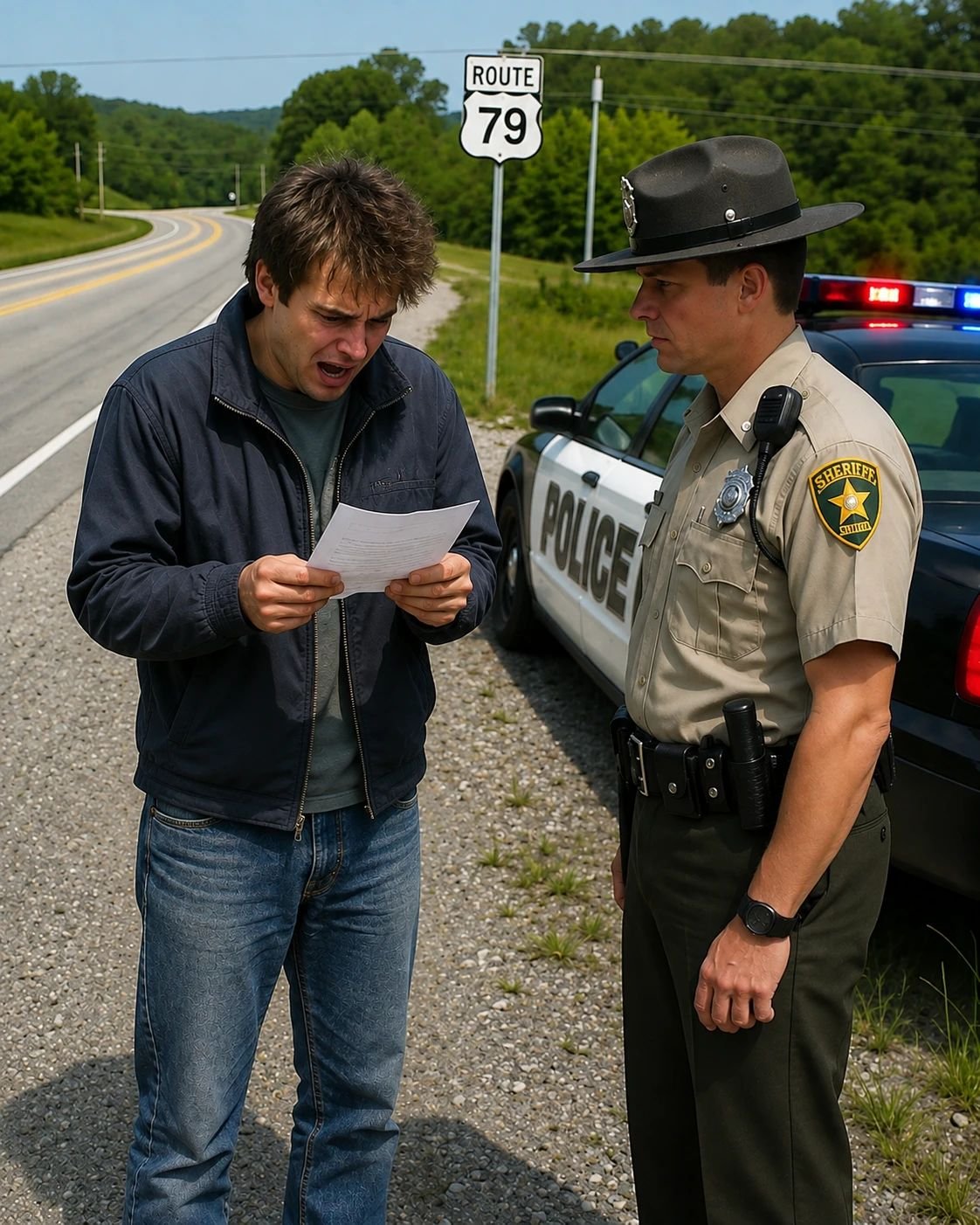
My wife got pulled over for speeding, and after the officer checked her license, he asked me to step out of the car. His face turned serious. “Sir, you need to hear me carefully. Do not go home tonight. Go somewhere safe.” I just stared at him. “What? Why?”
He hesitated, then lowered his voice. “I can’t explain it here. But what I found is bad. Very bad.” Then he slipped a note into my hand. When I opened it, my whole world changed.
Part 1: The Traffic Stop
The patrol car’s lights washed over our Honda Civic in red and blue, turning the inside of the car into a flickering aquarium of color. It was the sort of traffic stop that happens every day on American highways and rarely becomes anything more than a warning, a ticket, and an irritated story told over dinner later. My wife, Sarah Williams Chen, had been driving seventy-eight in a sixty-five on Route 35, not dangerously fast, just fast enough to catch the eye of a state trooper working radar behind an overpass as we made our way toward her mother’s place in Millbrook on a gray Saturday afternoon. She handed over her license and registration with the calm competence of someone who had been stopped before and always emerged with nothing worse than a fine and a mildly disapproving lecture. When Officer Martinez asked if she knew why he had pulled her over, she gave him the small apologetic smile that had once charmed me in a crowded coffee shop near Columbia, back when we were both younger and still believed our lives would be built out of honesty because we ourselves intended to be honest people.
Officer Martinez took the documents and returned to his cruiser. I watched him through the rearview mirror, expecting the usual few minutes of typing and waiting, the little bureaucratic pause that stands between inconvenience and continuation. Instead, something in his posture changed. He sat straighter. He leaned toward the screen with a concentration that didn’t belong to a routine speeding stop. Minutes stretched. Traffic hissed past. Sarah adjusted the rearview mirror and brushed invisible lint from her sleeve. When the officer stepped out again, he did not return to her side of the car. He came to mine and tapped lightly on the passenger window.
“Sir, could I speak with you privately for a moment?” he asked.
There was nothing aggressive in his tone. That made it worse.
I glanced at Sarah. She looked confused, but not alarmed. I opened the door and followed him a short distance behind the car, far enough from the window that our voices would blur into the sound of passing traffic. The shoulder smelled faintly of hot asphalt and engine exhaust. The late sun pressed against the side of my face. Officer Martinez turned toward me and held my gaze in a way that made my stomach tighten before he had said a word.
“Sir, I need you to listen carefully,” he said. “Do not go home tonight. Get somewhere safe. A hotel, a friend’s house, anywhere she doesn’t know about.”
For one second I honestly thought I had misheard him.
I stared at him, waiting for the sentence to rearrange itself into something reasonable. “What are you talking about? Is Sarah in some kind of trouble?”
His jaw flexed. Instead of answering directly, he pulled a small folded sheet of paper from his shirt pocket and pressed it into my hand. “Read this later,” he said. “When you’re alone. And be very careful who you trust.”
I looked down at the paper, then back at him. “Officer, I don’t understand. We’ve been married ten years. We’re just driving to visit her mother.”
He lowered his voice further. “Your wife’s name triggered alerts in our system. Serious ones. I can’t explain everything here, but I’m telling you this because your safety may depend on it.”
I turned instinctively toward the car. Sarah was sitting exactly where I had left her, one hand on the steering wheel, the other adjusting a strand of hair behind her ear. In the flashing lights from the cruiser, her face looked subtly different, sharpened somehow, less like the woman I knew and more like a version of her that had always existed just past the edge of my understanding. Officer Martinez returned to the driver’s window, handed her license and registration back, and issued a standard verbal warning with the same professional calm he had shown from the start. Nothing in his manner suggested to her, or to anyone passing by, that he had just shattered the foundation of my life on the shoulder of a state highway.
We merged back into traffic. Sarah was quiet the rest of the drive, quieter than a mere speeding stop should have made her. Her hands stayed a little too tight on the wheel. She checked the rearview mirror too often. When I asked if she was upset, she smiled and said no, but the smile passed over her face without touching anything underneath. I could feel the folded note in my pocket like a hot coin, impossible to ignore and impossible to explain.
By the time we reached her mother’s house, I had already started looking at my wife as if the edges of her had shifted and I was only just beginning to notice.
Sarah killed the engine, but she didn’t open her door.
For three seconds, maybe four, we sat in the driveway beneath a maple tree dripping last night’s rain onto the roof.
Tick.
Tick.
Tick.
Her mother’s house stood fifty feet away, a wide white Colonial with dark shutters and a porch Sarah had once told me her father built by hand before he died.
Warm light glowed behind the front curtains.
A figure moved across one window.
Sarah’s mother.
Elaine.
My hand slid into my jacket pocket and closed around Officer Martinez’s folded note.
Sarah noticed.
“What are you doing?”
“Nothing.”
Her eyes dropped toward my pocket.
Then back to my face.
That was the first moment I became certain she knew.
Not what the note said.
That there was a note.
Something cold moved through me.
Sarah smiled.
“Come on. Mom probably has dinner ready.”
She reached for the door handle.
I heard Officer Martinez again.
Do not go home tonight.
Go somewhere safe.
Anywhere she doesn’t know about.
And be very careful who you trust.
I needed to see what was on that paper before I walked into another house with Sarah.
“I left my phone charger at the gas station.”
Sarah stopped.
“We haven’t been to a gas station.”
My mouth went dry.
“I mean the coffee place.”
“We didn’t stop for coffee either.”
Silence.
The tiny blue dashboard clock glowed between us.
5:42.
Sarah turned slowly toward me.
Ten years of marriage had taught me a thousand versions of her face.
Amused.
Tired.
Tender.
Annoyed.
Hungry.
Half asleep.
This one was new.
It was almost expressionless.
Then she laughed.
“You’re rattled from the traffic stop.”
“Maybe.”
“Come inside.”
“I need a minute.”
“Why?”
I looked at her.
The question was too quick.
Too sharp.
“Because I need a minute.”
Her fingers tightened on the door handle.
Then released.
“Okay.”
She smiled again.
“I’ll tell Mom you’re taking a call.”
I watched her walk toward the house.
She didn’t look back.
The second the front door closed, I pulled out the note.
My hands were already shaking.
Officer Martinez had written in block letters.
DO NOT LET SARAH KNOW I WARNED YOU.
THE LICENSE NUMBER SHE GAVE ME IS ASSOCIATED WITH TWO IDENTITIES.
THE PHOTO MATCHES YOUR WIFE.
THE SECOND NAME IS SARAH ELIZABETH VALE.
THAT NAME IS FLAGGED IN CONNECTION WITH A FEDERAL WITNESS-TAMPERING INVESTIGATION AND A 2017 MISSING-PERSON CASE.
THE MISSING PERSON IS DANIEL CHEN.
YOUR BROTHER.
I stopped breathing.
The paper slipped from my hand.
Daniel.
For a moment, the driveway disappeared.
I saw my brother at twenty-nine, standing in my kitchen with a beer in one hand and a stupid grin on his face.
I saw the navy tie he wore to my wedding.
The way he had hugged Sarah and whispered something that made her laugh.
I saw the last photograph my mother ever took of the two of us together.
Daniel had disappeared eight years earlier.
Two years into my marriage.
His car had been found at a commuter lot outside Newark.
His phone was never recovered.
Police believed he’d left voluntarily at first.
Then they stopped believing much of anything.
There had been no body.
No ransom demand.
No financial activity.
No farewell note.
Nothing.
My parents died without knowing what happened to him.
And now my wife’s hidden identity was connected to his case.
A sound escaped my throat.
Not a word.
Something smaller.
Broken.
I grabbed the steering wheel because the world tilted.
Then the front door opened.
Sarah stood beneath the porch light.
Even from fifty feet away, I knew she was looking directly at me.
I crushed the note into my fist.
She called my name.
“Michael?”
I forced myself to raise a hand.
“Coming.”
Everything inside me screamed to drive.
But my car was parked behind hers.
My keys were in Sarah’s purse.
A habit we’d developed years ago because she hated loose keys scratching her phone.
I suddenly understood how many tiny pieces of my life required trusting her.
I stepped out.
The evening air felt too thin.
Halfway to the porch, Sarah came down the steps.
“Are you okay?”
“Headache.”
“You look pale.”
“Probably haven’t eaten enough.”
She studied me.
Then slipped her hand into mine.
I almost recoiled.
Her skin was warm.
Familiar.
That was the horror of it.
If she’d felt monstrous, it would have been easier.
Instead, she felt like my wife.
She rubbed her thumb across my knuckles.
“Mom made pot roast.”
I looked at our joined hands and wondered whether those same fingers had touched my brother shortly before he vanished.
My stomach turned.
Inside, Elaine hugged me.
“Michael! Finally.”
She smelled like cinnamon and the lavender lotion she’d used for as long as I’d known her.
“You two must be starving.”
Sarah took off her coat.
Elaine looked at her daughter.
Something passed between them.
A glance.
Less than a second.
I would never have noticed it yesterday.
Tonight it felt like a conversation.
Dinner was torture.
Elaine talked about a neighbor’s roof.
Sarah complained mildly about the speeding stop.
I moved food around my plate and listened to every word as if there might be a hidden trapdoor beneath it.
Then Elaine said, “Did the officer give you any trouble?”
Sarah’s fork stopped.
“No.”
Elaine looked at me.
“Michael?”
I lifted my eyes.
“What?”
“The officer. Sarah said he asked you out of the car.”
I stared at my wife.
Sarah took a sip of water.
“How did you know that?” I asked Elaine.
Silence.
Tiny.
But real.
Elaine smiled.
“Sarah just told me.”
“No, I didn’t,” Sarah said.
The color left Elaine’s face.
There it was.
The first crack.
Sarah turned to her mother.
“Mom.”
Elaine looked down.
I stood.
My chair legs scraped against tile.
“What is going on?”
Sarah rose too.
“Michael.”
“No.”
I backed away from the table.
“What is going on?”
Elaine’s hand began trembling around her napkin.
Sarah’s voice softened.
“You’re scared.”
That word confirmed everything.
She knew.
My heart pounded.
“Where are my keys?”
“In my purse.”
“Give them to me.”
“Sit down.”
“Give me my keys.”
“Michael, please.”
I moved toward the entryway.
Sarah stepped in front of me.
Not touching.
Blocking.
“Move.”
Her eyes filled.
“There’s something I need to tell you.”
I laughed once.
It sounded terrible.
“Your real name?”
She went completely still.
Elaine whispered, “Oh God.”
Sarah looked at my closed fist.
The note.
She understood.
Her face changed.
“Martinez.”
I took a step backward.
She knew his name.
Officer Martinez had never introduced himself in front of her.
At least not by name.
“Stay away from me.”
“Michael, listen.”
“How do you know the officer’s name?”
“I saw the nameplate.”
“No, you didn’t.”
“I did.”
“Where is Daniel?”
Silence.
Elaine made a small sound.
Sarah’s eyes closed.
My knees almost gave out.
I didn’t need another answer.
I said it again.
“Where is my brother?”
Sarah opened her eyes.
“He’s alive.”
The room vanished.
I heard the refrigerator humming.
The rain beginning again against the windows.
A spoon hitting the floor from Elaine’s hand.
I stared at Sarah.
“What?”
“Daniel is alive.”
I crossed the distance between us before I knew I had moved.
“Where?”
She flinched.
Not from me.
From the desperation in my voice.
“Michael—”
“WHERE?”
Elaine began crying.
Sarah looked at her mother.
Then at me.
“Eight years ago, Daniel discovered something he wasn’t supposed to know.”
“About you?”
“Yes.”
“What?”
Sarah swallowed.
“My father didn’t die when I told you he did.”
I stared.
“He died three years before we met.”
“No.”
Her voice broke.
“He was in federal custody.”
Elaine covered her face.
Sarah continued.
“My father was an accountant for a logistics company that laundered money for organized crime. When he agreed to testify, our family entered witness protection.”
The walls seemed to lean inward.
“My name was Sarah Vale.”
She took a shaky breath.
“We became Williams.”
“You married me under a false identity.”
“Yes.”
“For ten years.”
“Yes.”
“And Daniel found out.”
“He found an old photograph.”
I couldn’t speak.
“He confronted me. He thought I was running from something criminal. He started asking questions.”
“So you made him disappear.”
“No.”
The answer came violently.
“No. I swear to you.”
“Then why is your name connected to his missing-person case?”
“Because I helped him disappear.”
My vision blurred.
Sarah pressed both palms against the table.
“Daniel found my father.”
“What?”
“He traced an old storage unit lease. He found documents. He contacted someone he thought was a federal investigator.”
She looked at Elaine.
“It wasn’t.”
Elaine sobbed.
Sarah continued.
“The people my father testified against learned Daniel had connected himself to us.”
I could barely follow.
“They threatened him?”
“They threatened you.”
I froze.
Sarah looked directly at me.
“That was why Daniel agreed to leave.”
My mouth opened.
Nothing came out.
“He knew if he stayed, they would use him to reach me, my mother, and you.”
“You expect me to believe my brother abandoned us willingly?”
“No.”
Her eyes filled.
“I expect you to hate me when I tell you that I helped convince him.”
I stared.
“He wanted to tell you. I begged him not to.”
“Why?”
“Because you would have followed him.”
“Of course I would have.”
“And then you would have been in danger too.”
I laughed bitterly.
“So you decided for me.”
“Yes.”
“You watched me search for him.”
Tears spilled down her face.
“Yes.”
“You watched my mother die without knowing where her son was.”
Sarah’s mouth trembled.
“Yes.”
“You watched my father blame himself.”
She whispered, “Yes.”
Something inside me tore open.
I picked up a glass and threw it against the wall.
It shattered.
Elaine screamed.
Sarah didn’t move.
“You lied to me every day.”
“Yes.”
“Every single day.”
“Yes.”
“I buried my parents with this.”
Her face collapsed.
“I know.”
“No, you don’t.”
I stepped toward her.
“You don’t get to say that.”
She nodded.
“You’re right.”
A phone vibrated.
Not mine.
Sarah’s.
She looked toward the counter.
The screen lit.
UNKNOWN CALLER.
Her face drained.
“Don’t answer it.”
I stared at her.
“Why?”
“Because nobody calls that number.”
The phone stopped.
Then vibrated again.
A message appeared.
I was close enough to read it.
YOU SHOULD HAVE KEPT DRIVING.
Sarah stopped breathing.
Elaine whispered, “They found us.”
The dining room changed instantly.
Sarah became someone else.
Not colder.
Focused.
She grabbed the phone.
“Mom, basement. Now.”
Elaine stood.
I didn’t move.
Sarah turned to me.
“Michael, if you hate me, hate me tomorrow. Right now, go downstairs.”
“Who are they?”
She crossed to a drawer and pulled out a small handgun.
My blood went cold.
She checked it with practiced hands.
“You have a gun?”
“Michael.”
“You have a gun in your mother’s kitchen?”
“Go downstairs.”
Headlights swept across the front windows.
A vehicle stopped outside.
Sarah killed the dining-room lights.
Darkness swallowed us.
Then someone knocked.
Three slow knocks.
Elaine began shaking.
Sarah whispered, “Basement.”
This time I moved.
Not because I trusted her.
Because fear sounded different when it was real.
We descended into a low unfinished basement smelling of concrete and laundry detergent.
Sarah followed but stayed halfway up the stairs.
Another knock.
Then a voice.
“State Police.”
I stared upward.
Sarah didn’t relax.
“Which officer?”
No answer.
Then—
“Ms. Chen, we’re here because of the traffic stop.”
Sarah looked at me.
Her expression said everything.
They knew my name.
A crash exploded upstairs.
Elaine screamed.
Sarah pushed the basement door shut and locked it.
Then she pulled a metal shelving unit across it.
I heard footsteps.
More than one person.
Sarah dialed 911.
No signal.
She cursed.
“There’s a landline in the utility room.”
Elaine pointed.
I grabbed it.
Dead.
Sarah whispered, “They cut it.”
Then three gunshots punched through the basement door.
We dropped.
Wood splintered.
Elaine cried out.
Sarah crawled toward me.
“Behind the furnace.”
“What are you doing?”
“Buying time.”
“No.”
For the first time that night, the answer came from me before fear could edit it.
“No more deciding for me.”
Her face tightened.
“This isn’t the moment.”
“This is exactly the moment.”
Another shot.
The lock exploded.
Sarah grabbed my shoulders.
“Michael, listen to me.”
“No. You listen.”
My voice shook.
“You lied because you thought choosing for me was love.”
Her eyes widened.
“You don’t get to do it again.”
The basement door shuddered.
I pointed toward a narrow cellar window.
“We all go.”
Sarah looked at it.
Too small for Elaine.
Then she looked at her mother.
“No.”
Elaine suddenly grabbed Sarah’s face with both hands.
“Go.”
“Mom.”
“I am done hiding.”
Sarah froze.
Elaine’s voice steadied.
“I let your father make every decision because I was afraid. Then I let you carry it because I was afraid.”
The door cracked.
Elaine shoved the gun back toward her daughter.
“Take your husband and go.”
“No.”
“Sarah.”
Her voice became fierce.
“I am your mother. For once, let me make the hard choice.”
Then we heard sirens.
Real ones.
Several.
Red and blue light strobed faintly through the cellar window.
The footsteps upstairs stopped.
A man’s voice shouted.
“MOVE.”
Then running.
A door slammed.
Engines roared.
Sarah collapsed against the wall.
I didn’t understand until twenty minutes later.
Officer Martinez had been waiting.
He had known the alert on Sarah’s license would notify people monitoring certain records.
He had warned me because he didn’t know which side Sarah was on.
But after we left, he had done something else.
He had called the federal task force attached to Sarah Vale’s identity.
The men who came to Elaine’s house were arrested six miles away after a pursuit.
One of them was Harrison Pike, a former security contractor whose name appeared repeatedly in the federal witness-tampering investigation.
And inside his vehicle police found something that changed everything again.
A photograph.
Recent.
A man leaving a grocery store in Vermont.
Gray at the temples.
Beard.
Older.
But unmistakable.
Daniel.
I held the photograph with both hands in the back of an ambulance while rain hit the roof.
“He’s alive.”
Sarah sat across from me with a blanket around her shoulders.
“Yes.”
“You knew where he was.”
“No.”
I looked up sharply.
“I knew he entered a federal relocation program under another name. I never knew where.”
“Why not?”
“Because he demanded I never be told.”
That hurt in a new place.
“He didn’t trust you?”
“He didn’t trust himself.”
I stared.
Sarah’s lips trembled.
“He knew if he contacted me, eventually he’d ask about you. And if he knew anything, he thought he’d try to come back.”
I looked at the photograph.
“My brother chose this.”
“Yes.”
“But you helped him choose.”
“Yes.”
We sat in silence.
Then Sarah reached into her coat and pulled out a small sealed envelope.
My name was written across it.
In Daniel’s handwriting.
I knew immediately.
My hands stopped working.
“Where did you get this?”
“He gave it to me the night he left.”
I stared at her.
“You’ve had this for eight years?”
Tears filled her eyes.
“Yes.”
The rage returned so fast I nearly dropped it.
“Why didn’t you give it to me?”
“Because he made me promise I wouldn’t unless the danger was over.”
“You chose his promise over my grief.”
“Yes.”
I stood.
The ambulance seemed suddenly too small.
“Michael—”
“No.”
I stepped into the rain.
I opened the letter under the flashing emergency lights.
Mike,
If you’re reading this, either I’m dead or someone finally decided the truth is safer than the lie.
I need you to understand one thing before you blame Sarah.
This was my choice.
Not entirely at first. I was angry. I thought she and her mother were criminals. Then I found out what her father had done and what the people looking for him were capable of.
They sent me a picture of you leaving work.
That was enough.
I could stay and risk them using you to reach Sarah, or I could disappear and make myself useless to them.
I chose to disappear.
Sarah begged me to tell you.
I was the one who said no.
Because I know you.
You would have come after me.
You would have gotten yourself killed trying to save me.
So if you hate someone, hate me too.
But don’t let this destroy whatever good you and Sarah have.
She loves you.
That’s the thing she was worst at hiding.
I’m sorry, little brother.
For everything.
Daniel
I read the letter twice.
Then a third time.
Rain soaked through my clothes.
Sarah stood ten feet away.
She didn’t approach.
For once, she let me decide the distance.
I folded the letter.
“Why did you tell me you begged him not to tell me?”
Her face crumpled.
“Because I did.”
I stared.
“The letter says you begged him to tell me.”
“At first.”
She wiped rain from her cheek.
“Then I got scared.”
There it was.
The ugliest truth.
Not a clean villain.
Not a clean victim.
Fear.
Human and selfish and complicated.
“I changed my mind. I told him he was right. That telling you would put you in danger.”
She looked down.
“So both things are true.”
I closed my eyes.
That somehow made the letter more believable.
Three days later, federal agents arranged a secure video call.
I sat alone in a government office.
The screen was black.
Then it flickered.
My brother appeared.
Older.
Thinner.
Alive.
For several seconds, neither of us spoke.
Daniel’s mouth opened.
“Hey, Mike.”
I stood so fast the chair hit the wall.
“You son of a bitch.”
He laughed.
Then started crying.
So did I.
“You’re alive.”
“Yeah.”
“You’re alive.”
“I know.”
“You let me think you were dead.”
His face folded.
“I know.”
I pressed both hands against the desk.
“Mom died.”
His eyes closed.
“I know.”
“Dad too.”
“I know.”
“They never knew.”
“I know.”
I hated that answer.
I hated how much pain fit inside two words.
“Why didn’t you come back?”
“Because the threat never fully went away.”
“And now?”
He looked offscreen.
“Now Pike is in custody. His network is collapsing. The prosecutors think the remaining risk can be managed.”
“Can I see you?”
Daniel began crying again.
“Yes.”
That was the moment my anger broke.
Not disappeared.
Broke open.
Four days later, I saw my brother in person at a secure federal facility.
He stood behind a glass door.
For a second, neither of us moved.
Then the lock clicked.
I crossed the room.
He crossed it too.
We collided.
There is no elegant way for grown men to grieve eight missing years.
I hit his shoulder.
He grabbed the back of my coat.
I called him an idiot.
He said he knew.
I told him I hated him.
He said he knew that too.
Then I held my brother while both of us cried into each other’s shirts like children.
Sarah didn’t come.
I had told her not to.
She respected that.
That mattered.
When I returned home, I did not go to our house.
I rented an apartment.
Sarah stayed with Elaine.
For two months, we saw each other only in a therapist’s office.
The first session lasted nineteen minutes before I walked out.
The second lasted thirty-seven.
By the fifth, I could look at her without imagining every lie.
By the ninth, I finally said the thing underneath all the others.
“I don’t know which memories are real.”
Sarah went still.
“All of them.”
“You lied through them.”
“Yes.”
“How do I know the woman laughing with me on our honeymoon was really you?”
“Because I was laughing.”
“How do I know the woman who held me when my mother died meant it?”
Her face collapsed.
“Because I loved her too.”
I looked away.
“She died grieving Daniel.”
“I know.”
“Stop saying that.”
Sarah pressed her lips together.
Then she whispered, “Okay.”
Silence.
Our therapist didn’t interrupt.
Sarah picked at a thread on her sleeve.
Finally she said, “I don’t know how to ask you to forgive me without making forgiveness another thing I take from you.”
That was the first honest sentence that reached me.
So I answered honestly.
“Don’t ask.”
She nodded.
“Okay.”
Daniel eventually returned under his own name.
Not immediately.
There were hearings.
Security evaluations.
Testimony.
He became a key witness against Pike and two other men connected to the network that had spent years intimidating witnesses and their families.
Sarah testified too.
So did Elaine.
The hidden identity that had protected them became public record in limited proceedings.
Sarah lost a consulting job when the press picked up part of the story.
She didn’t fight it.
“I built my life around secrecy,” she told me one night. “I can’t complain when truth has consequences.”
Pike was convicted.
The evidence included financial records, intercepted communications, and the threats sent to Daniel years earlier.
His own emails showed he’d ordered the surveillance of me.
The photograph Daniel had described in his letter was found on an encrypted drive in Pike’s possession.
For eight years, I’d believed my brother vanished into nothing.
Now there were dates.
Names.
Transactions.
Proof.
Truth didn’t erase the lost years.
But it gave the grief somewhere to land.
Officer Martinez received a commendation for his handling of the traffic stop.
I asked him once why he warned me.
We were standing outside the courthouse after Pike’s sentencing.
He thought for a moment.
“Because when your wife’s license triggered that alert, there was a note in the federal file.”
“What note?”
“If encountered with spouse Michael Chen, separate and assess immediate risk. Spouse may be uninformed.”
I looked at Sarah across the courthouse steps.
She was speaking quietly with Daniel.
“Who put that there?”
Martinez smiled faintly.
“Your brother.”
I stared.
Daniel saw me looking.
He lifted one hand.
And suddenly the traffic stop changed in my memory.
The warning had not been random.
Even while hiding, Daniel had left one final line of protection around me.
A contingency.
A way to say, if the lie ever breaks open, get my brother somewhere safe.
That was the beautiful cruelty of it.
The man I had spent eight years believing had abandoned me had been trying to protect me the entire time.
Poorly.
Painfully.
But truly.
A year after the traffic stop, Daniel came to Thanksgiving.
The first real one.
He stood on my porch holding a pie.
“You bake now?”
“No.”
“Good.”
“Bought it.”
“Safer.”
He laughed.
Sarah arrived twenty minutes later.
We were not living together.
Not yet.
But we were trying.
Slowly.
No grand reunion.
No pretending love canceled betrayal.
She came through the door carrying green beans.
Daniel looked at her.
For a moment, the room held eight years of secrets.
Then he said, “You look old.”
Sarah stared at him.
“You disappeared for eight years.”
“Stressful lifestyle.”
She laughed.
Then covered her mouth.
And suddenly she was crying.
Daniel crossed the room.
She didn’t move.
He hugged her.
She clutched his shirt.
“I’m sorry.”
“I know.”
“No.”
She pulled back.
“I need you not to do that.”
Daniel frowned.
“Do what?”
“Say I know like it makes everything okay.”
He looked at me.
I almost smiled.
Apparently that phrase had become a family problem.
Daniel nodded.
“Okay.”
Sarah wiped her face.
“I failed him.”
She looked at me.
“I thought keeping Michael alive justified everything I took from him.”
Daniel’s expression softened.
“I was part of that.”
“Yes.”
“No, Sarah. I mean it.”
He looked at me.
“I made you a prisoner of my choice too.”
I stared at him.
He lowered his eyes.
“I told myself you were safe, so it was worth it.”
His voice broke.
“But safe isn’t the same thing as whole.”
Nobody spoke.
Elaine stood near the stove with tears running silently down her face.
Then she said, “That is what fear did to all of us.”
Sarah looked at her mother.
Elaine continued.
“It kept us alive.”
She wiped her hands on a dish towel.
“And then we kept obeying it long after it stopped saving us.”
That sentence stayed with me.
Sarah moved back into our house six months later.
Not because trust had magically returned.
Because enough small things had changed.
She gave me access to every document she could legally share.
She stopped using silence as protection.
When she didn’t know whether she could tell me something, she said exactly that.
When I got angry, she didn’t tell me I was safe.
She let me be angry.
When I woke at two in the morning and asked a question I’d already asked five times, she answered it a sixth.
Daniel came over on Sundays.
Sometimes we talked about the missing years.
Sometimes we didn’t.
One afternoon, I found him fixing a loose cabinet hinge.
“You still hate me?”
He didn’t look up.
“Sometimes.”
I leaned against the counter.
“Good.”
He glanced over.
“Good?”
“Means you’re not pretending.”
I laughed.
He smiled.
Then he tightened the screw.
“I hated you too.”
“For what?”
“For having the life I wanted.”
The screwdriver stopped.
“You had Sarah. Mom. Dad. A home.”
His eyes dropped.
“I had three names, two safe houses, and a government employee who inspected my mail.”
I swallowed.
“I thought you were free.”
He looked at me.
“I thought you were.”
That was the tragedy.
We had each envied the prison we imagined the other escaped into.
Two years after the traffic stop, Sarah and I drove Route 35 again.
Same highway.
Different car.
The afternoon was clear.
When we passed the overpass where Officer Martinez had been running radar, Sarah slowed instinctively.
I noticed.
“So now you obey speed limits.”
“I’ve become deeply respectful of traffic enforcement.”
I laughed.
She smiled.
There were more lines around her eyes now.
I liked them.
They belonged to the face I finally knew.
Not perfectly.
Nobody knows another person perfectly.
That illusion had caused enough damage.
We stopped at a diner near Millbrook.
Sarah ordered coffee.
I folded the paper napkin between my fingers.
She watched me.
“What?”
I took out something I’d carried for weeks.
Officer Martinez’s note.
The original.
Wrinkled.
Soft at the folds.
Sarah stared at it.
“You kept it.”
“Yes.”
“Why?”
I looked at the block letters.
DO NOT GO HOME TONIGHT.
That sentence had terrified me.
For a long time, I’d thought the note was the moment my life fell apart.
It wasn’t.
My life had been fractured for years.
The note was simply the first honest thing sharp enough to split the lie open.
“I think I kept it because it saved me.”
Sarah’s eyes filled.
“From me?”
I thought about that.
“No.”
She waited.
“From living another ten years without knowing.”
Her shoulders lowered.
I reached across the table.
She looked at my hand.
Then placed hers in it.
“I don’t forgive everything,” I said.
“I know.”
I raised an eyebrow.
She caught herself.
“Sorry.”
I laughed.
She laughed too.
Then I became serious.
“I may never forgive some of it.”
Her fingers tightened.
“I understand.”
“But I’m here.”
“Yes.”
“And you’re here.”
“Yes.”
“And Daniel is alive.”
A tear rolled down her cheek.
“Yes.”
“That has to be enough for today.”
She nodded.
“For today.”
Outside, cars moved along the highway.
Ordinary people going ordinary places.
None of them knew that two years earlier a routine speeding stop had cracked open an eight-year disappearance, a false identity, a federal investigation, and a marriage built partly on truth and partly on terror.
I used to think the worst thing a person could discover was that someone they loved had lied.
I was wrong.
The worst thing is discovering why.
Because sometimes the reason is cruel.
Sometimes selfish.
Sometimes cowardly.
And sometimes it is love twisted by fear until it becomes almost unrecognizable.
That does not make the damage disappear.
It only makes the truth harder.
Sarah squeezed my hand.
“You ready?”
I looked through the window toward the road.
Elaine was expecting us.
Daniel would already be there, probably pretending he hadn’t eaten half the dessert before dinner.
Our house waited back in the city.
Not the same house it had been.
Not the same marriage.
Not the same people.
But ours.
I folded Officer Martinez’s note one final time.
Then, for the first time, I didn’t put it back in my pocket.
I left it on the table beneath the empty coffee cup.
Sarah noticed.
She said nothing.
We stood.
Outside, the sun had begun to lower over the highway.
She reached for my hand but stopped an inch away.
Waiting.
That tiny hesitation meant more to me than any promise she had ever made.
I closed the distance myself.
Our fingers intertwined.
We walked toward the car.
No red and blue lights.
No warnings.
No hidden names.
Just the road ahead.
And this time, when Sarah turned the key and asked me where I wanted to go, I looked at the woman beside me, thought of my brother waiting at the other end, and answered without fear.
“Home.”