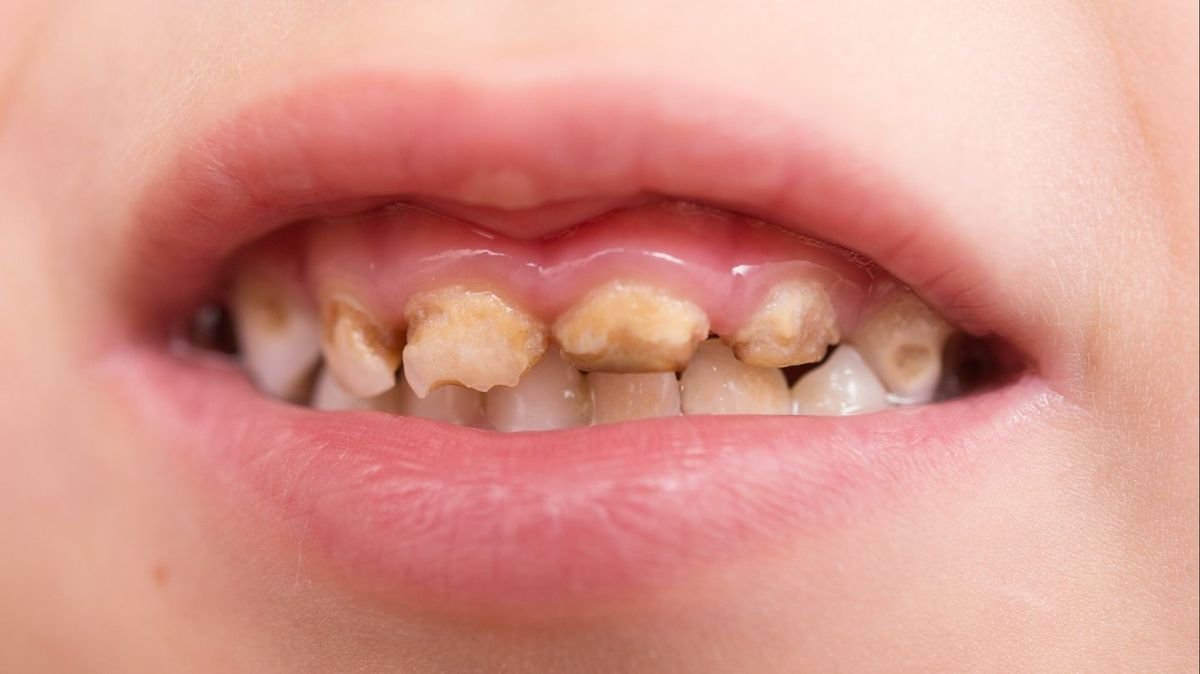
Having a good set of teeth is key for confidence and for health, too, but now an increasing number of children are developing an unusual dental condition that is causing their smiles to crumble.
It used to be very rare, with not much known about it, but now more children than ever are developing the unusual condition.
According to the Daily Mail, one in six children is now being left with yellowed, brittle teeth that are breaking apart in their mouths – and it’s all thanks to molar incisor hypomineralisation’ (MIH).
What is molar incisor hypomineralisation?
MIH is when the protective enamel doesn’t form properly on the teeth, the NHS explains, leaving them at a higher risk of tooth decay and damage. In many cases, patients find that their teeth start to crumble away.
This disintegration has earned the condition the nickname ‘chalk teeth’.
Enamel is mostly made up of minerals such as phosphate and calcium, but with MIH they have higher levels of protein instead.
The condition tends to become visible at the age of around six, when the child’s adult teeth emerge.
What causes molar incisor hypomineralisation?
Most people see damaged teeth and assume it’s down to a lack of brushing, or an excess of sugar along with a bad diet. With MIH, that’s sadly not the case, but the stigma can be real.
Instead, it’s caused by how the enamel forms in those crucial early days of childhood and actually has nothing to do with oral health. myPediaclinic says research in pediatric dentistry points at the following factors for the most common causes:
- Early childhood illness: High fevers, severe illness, or hospitalisation in the first 3 years of life (when enamel is developing) correlate with MIH.
- Perinatal factors: Premature birth, low birth weight, birth trauma, maternal illness during pregnancy.
- Antibiotic use: Repeated antibiotic courses in early childhood, particularly amoxicillin and tetracyclines.
- Environmental factors: Potentially dioxins, other environmental chemicals.
- Genetic susceptibility: Some children appear genetically predisposed.
- Nutritional factors: Vitamin D deficiency has been associated.
- Breastfeeding duration: Links to long breastfeeding duration have been suggested but aren’t fully proven.
Traditional tooth decay is slowing thanks to education and better tooth brushing practices, however, experts are finding that MIH is on the rise instead.
It was first recognised in the 1980s, but it is also increasing across Europe.
Norwegian scientists have found that the numbers are even higher in Scandinavian countries, with a whopping one-in-three children in the region being afflicted.
‘It’s not anything to do with how a child’s teeth are taken care of’
Dr Helen Rodd, Professor of paediatric dentistry at the University of Sheffield, told the Daily Mail that they don’t know why MIH is on the rise.
“It’s not anything to do with how a child’s teeth are taken care of, because these teeth are developing at birth, they’re coming in around the age of six or so, with teeth that are already discoloured and crumbling. We just can’t explain it,” she added.
Professor Greig Taylor, clinical lecturer in paediatric dentistry at Newcastle University and a spokesman for the British Society of Paediatric Dentistry, added: ‘It’s about the amount of mineral in the tooth.’
To make it more confusing, it doesn’t always impact every tooth – some children will just have one tooth with it, while others will find every tooth crumbling.
Professor Taylor added: “The effect on the tooth itself also ranges. In a mild case it may look like little white flecks – while on another the tooth may be dark brown and totally broken down.”
When molars at the back are effected, it can leave behind sensitive pulp and cause extreme pain, while the front teeth tend to have a more cosmetic impact.
“In front teeth, it often presents as discrete, white, yellow, brown or cream spots. They don’t crumble and break away, as back teeth do,” Professor Taylor explained. “But while this doesn’t affect chewing, it can impact quality of life for a child. They might not want to smile or go to school.”
It’s important parents don’t feel guilty, as Professor Taylor reminded: “We still don’t know enough about MIH to go back in a child’s life and pick out what caused it.
“Often there’s no clear event or illness at all. It’s simply not in a parent’s control. Instead, the emphasis needs to be on how to recognise and manage it.”