The Crash That Changed Two Worlds Forever
In the middle of World War II, when the Pacific Ocean had become a battlefield and thousands of soldiers disappeared without a trace, one American pilot fell from the sky into one of the most unforgiving places on Earth.
His name was Fred Hargesheimer.
He was twenty-seven years old when his reconnaissance aircraft was shot down over the island of New Britain in 1943. Below him was not a friendly base, not an open field, not a place where rescue teams could easily reach him.
Below him was a vast tropical rainforest controlled by the Japanese military.
For an Allied pilot, being stranded behind enemy lines was almost a guaranteed death sentence.
The Japanese army was searching aggressively for downed American and Australian airmen. Any local person caught helping an enemy soldier could face brutal punishment — including execution.
Fred had no radio.
No weapon.
No food.
No map.
Only the instinct to survive.
For thirty-one days, he disappeared into the jungle.
When he finally emerged, he was no longer the strong young pilot who had climbed into his aircraft weeks earlier. He was exhausted, starving, feverish, and barely able to stand.
He believed the voices he heard coming from the trees meant one thing:
The Japanese had found him.
But instead of soldiers carrying rifles, he saw something he never expected.
A group of Nakanai tribesmen had discovered him.
And in the darkest moment of his life, these villagers made a decision that would change history.
They chose to save an enemy pilot.
They chose compassion over fear.
And decades later, Fred Hargesheimer would dedicate the rest of his life proving that one act of kindness had never been forgotten.
The Day the Sky Fell
The year was 1943.
World War II was raging across the Pacific. Islands that had once been peaceful homes to thousands of people had become strategic battlefields between the Japanese Empire and Allied forces.
New Britain, located in what is now Papua New Guinea, was one of those places.
The island was covered with thick jungle, towering mountains, dangerous rivers, and thousands of square miles of unexplored wilderness.
For Allied pilots flying reconnaissance missions, every flight carried enormous risks.
Their job was to gather intelligence, locate enemy positions, and help commanders understand what was happening on the ground.
Fred Hargesheimer was one of those pilots.
He was young, determined, and committed to his mission.
But on one mission in 1943, everything changed.
His aircraft was hit.
The damage was catastrophic.
The plane began falling toward the jungle below.
There was no safe landing area.
No friendly territory.
No possibility of immediate rescue.
The aircraft crashed deep inside Japanese-controlled territory.
Fred survived the impact, but survival was only the beginning.
The jungle itself became his enemy.
The heat was overwhelming.
The insects were everywhere.
Every sound could have meant danger.
And somewhere beyond the trees, Japanese patrols were searching.
Fred knew that if he was captured, he might never leave the island alive.

Thirty-One Days Alone in the Rainforest
The first days were a battle against hunger and exhaustion.
Fred had almost nothing.
He searched for anything edible.
He drank water from streams.
He survived on whatever roots and plants he could find.
The jungle offered no comfort.
During the day, he often remained hidden.
At night, when darkness covered the forest, he moved carefully through the trees, trying to avoid Japanese soldiers.
Every step was dangerous.
Every decision mattered.
A wrong turn could lead directly into an enemy camp.
A careless sound could reveal his location.
As the days passed, his physical condition deteriorated.
The strong pilot who had once controlled an aircraft above the Pacific was now struggling simply to remain conscious.
Thirty days passed.
Then thirty-one.
By that point, Fred was almost convinced that death was coming.
His body was failing.
His strength was disappearing.
Hope was becoming harder to hold onto.
Then, on the thirty-second day, he heard voices.
The sound came from somewhere among the trees.
Fred froze.
His first thought was terrifying:
The Japanese had found him.
But when the figures appeared, he realized these were not enemy soldiers.
They were Nakanai villagers.
And they were about to become the reason he lived.
The Village That Risked Everything for a Stranger
The Nakanai people understood the danger immediately.
They knew Fred was an American pilot.
They knew the Japanese controlled the island.
They knew what would happen if soldiers discovered they were hiding him.
The consequences could have been devastating.
The Japanese military had made it clear:
Anyone helping Allied soldiers was considered a traitor.
Yet the villagers did not turn him over.
They carried the weak and nearly unconscious pilot back to their coastal village.
They hid him.
They protected him.
They fed him.
Not because they expected money.
Not because they wanted recognition.
They did it because he was a human being in desperate need.
Fred was so weak that he could barely eat normal food.
His body had gone too long without proper nourishment.
Then one woman made a decision that Fred would remember for the rest of his life.
Her name was Ida.
She was a nursing mother.
She entered the small hut where Fred was lying and saw a man who was close to death.
Then she returned carrying something extraordinary.
A cup filled with her own breast milk.
For ten days, Ida fed Fred this way while also caring for her own baby.
It was not a dramatic battlefield rescue.
There were no cameras.
No newspapers.
No medals.
Just one person quietly giving another person the only thing she had that could keep him alive.
Fred never forgot her kindness.
The Secret Signals That Saved His Life
Fred’s survival depended not only on the villagers’ generosity but also on their courage and creativity.
Japanese patrols continued moving through the area.
At any moment, soldiers could arrive.
The villagers created a warning system.
Whenever Japanese troops approached, someone would quietly blow into a hidden conch shell.
That sound was a message:
Run.
Hide.
Disappear.
Fred would immediately move into hiding.
Sometimes he had only seconds.
The village children also played an important role.
When Fred had to cross the beach wearing his boots, they followed behind him carrying tiny palm-frond brooms.
Their mission was simple but incredibly important.
They swept away his footprints.
The children erased the evidence that an American pilot had passed through their village.
They were risking their own lives.
If the Japanese discovered what they were doing, the entire community could have suffered.
But nobody betrayed Fred.
Nobody abandoned him.
The children could not pronounce his name correctly.
“Fred” became difficult for them.
So they called him:
“Mastah Preddi.”
Master Freddie.
A name that would stay with him forever.
Seven Months Among the Nakanai People
Fred remained hidden with the Nakanai people for seven months.
During that time, he became more than a rescued soldier.
He became part of their community.
He learned their customs.
He experienced their generosity.
He formed bonds with people who had every reason to fear him as a foreigner but instead welcomed him as family.
The villagers had very little compared to the world Fred came from.
But they gave him everything.
Their food.
Their protection.
Their trust.
In February 1944, Australian commandos finally reached the area.
After months of uncertainty, rescue had finally arrived.
The Allied forces contacted an American submarine that could extract Fred from the island.
The moment of departure was emotional.
Fred climbed into a canoe and paddled toward the waiting submarine under the cover of darkness.
The villagers watched from the shore.
Many of them had no idea if they would ever see him again.
Some mothers reportedly offered Fred their own children, hoping he would take them to America and give them opportunities they could never provide.
It was a heartbreaking symbol of the trust they placed in him.
Fred left New Britain alive because strangers had decided he deserved to live.
But he never truly left them behind.
A Soldier Returns Home — But His Heart Stayed in the Jungle
After the war ended, Fred returned to Minnesota.
He married.
He raised children.
He built a normal life.
To anyone watching from the outside, he had moved forward.
But inside, one question followed him for years:
How do you repay someone who saved your life?
How do you repay an entire village that risked everything for you?
Fred thought about Ida.
He thought about the children with the palm-frond brooms.
He thought about the villagers who stood between him and death.
A simple thank you did not feel enough.
So in 1960, nearly two decades after the war, Fred made a decision.
He returned to New Britain.
The Return of Master Freddie
When Fred’s boat approached the shore, something unforgettable happened.
The villagers were waiting.
They recognized him.
The man they had saved as a young soldier had returned decades later.
As he stepped onto the beach, the community began singing the only English song many of them knew:
“God Save the Queen.”
Fred was overwhelmed.
He cried.
After all those years, the connection had never disappeared.
He found Ida again.
He met the son she had been nursing while she had also saved his life.
The reunion reminded him that the people who had rescued him were still living in the same difficult conditions.
The village that had given him life needed help.
And Fred decided he would give back.
From Minnesota Salesman to Village Builder
A missionary later told Fred that the village desperately needed a school.
Children had little access to education.
The community needed a place where future generations could learn.
So Fred began raising money.
He was not a wealthy man.
He did not have the power of a large organization behind him.
He simply went door to door in Minnesota.
He spoke to churches.
He shared his story.
He asked ordinary people to help a village thousands of miles away.
Slowly, donations came in.
Small contributions became something much bigger.
By 1963, Fred returned to New Britain and helped build the village’s first permanent school.
The pilot who had once been rescued by villagers was now helping build a future for their children.
But Fred did not stop there.
A Lifetime of Giving Back
Years later, Fred and his wife Dorothy made an extraordinary sacrifice.
They left America.
They moved to New Britain for four years.
They lived among the people who had saved him.
They taught children at the foot of a volcano, thousands of miles away from their original home.
For many people, gratitude ends with a donation or a letter.
For Fred, gratitude became a lifelong mission.
Over the decades, he repeatedly returned to the island.
He helped build:
Schools.
Libraries.
A medical clinic.
Facilities that improved the lives of generations of Nakanai children.
He did not view these projects as charity.
He viewed them as a debt of humanity.
The villagers had saved one life.
He wanted to help save many more.
The Warrior Chief Who Never Forgot
In 2000, the Nakanai people honored Fred in a way few outsiders ever received.
They officially made him a tribal chief.
They gave him the title:
“Suara Auru.”
Chief Warrior.
It was a remarkable honor.
The young American pilot who once arrived as a helpless stranger had become a respected member of their community.
Not because he had been a soldier.
Not because he had power.
But because he had spent decades proving that kindness deserves to be remembered.
One Final Journey Into the Jungle
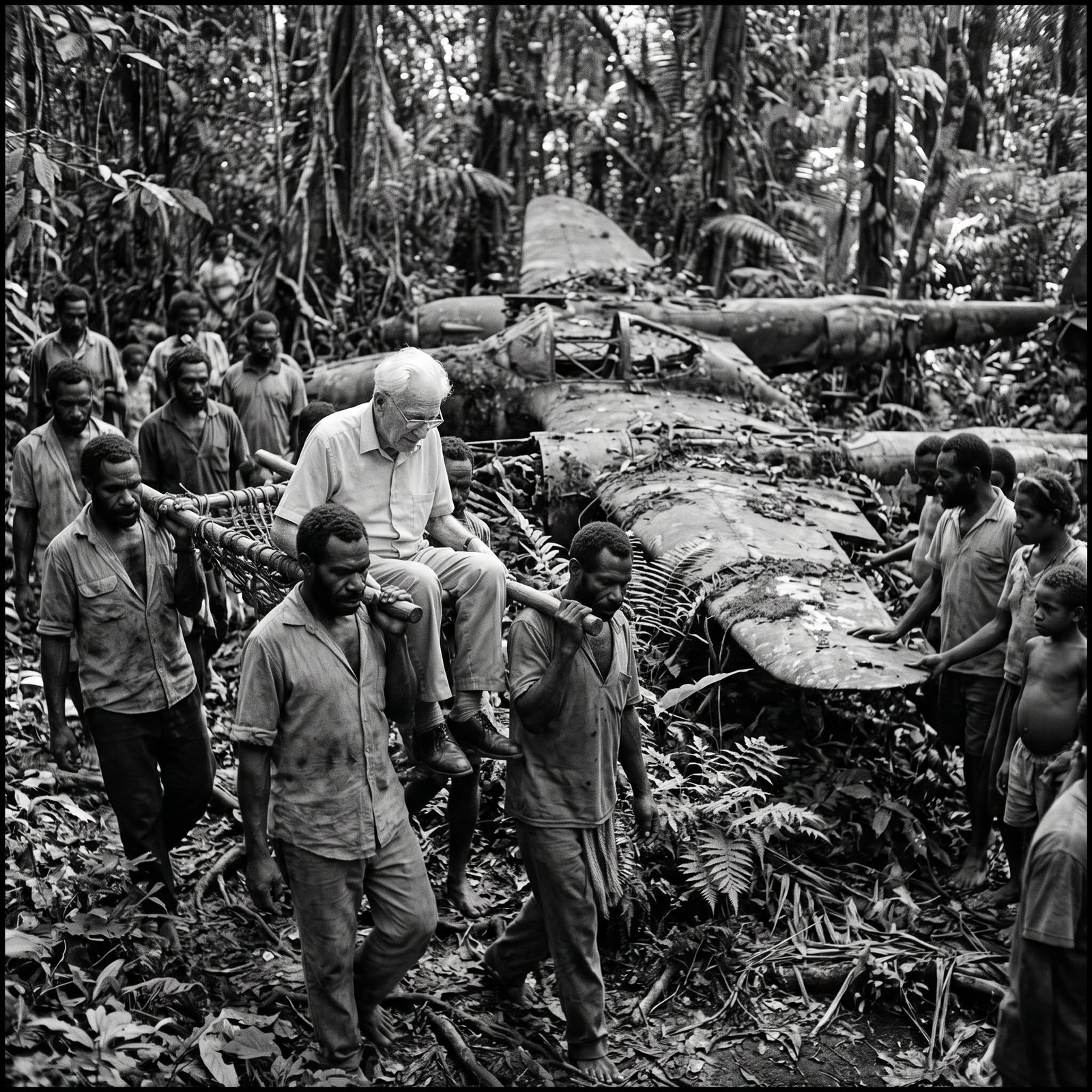
In 2006, at ninety years old, Fred made one final trip to New Britain.
The wreckage of his crashed aircraft had finally been discovered.
For more than sixty years, the jungle had hidden the remains of the plane that changed his destiny.
Fred wanted to see it.
The villagers carried the elderly man through the rainforest so he could reach the crash site.
The journey was difficult.
But they refused to let him miss that final moment.
There, beneath the trees, rested the broken aircraft that had brought him into their lives.
The same wreckage that had caused so much suffering had also created a bond that lasted generations.
Fred looked at the remains of the plane and saw more than metal.
He saw the beginning of a story about courage, compassion, and humanity.
The Legacy of Master Freddie
Fred Hargesheimer died in 2010 at the age of ninety-four.
But his story did not end with his death.
The schools he helped build continue serving children.
The clinic continues helping families.
The friendship between an American pilot and the Nakanai people remains one of the most extraordinary examples of gratitude in modern history.
When people asked Fred why he spent nearly seventy years helping a village he could have forgotten after the war, his answer was always simple:
“These people were responsible for saving my life. How could I ever repay it?”
He spent the rest of his life trying.
And perhaps that is the greatest lesson of Fred Hargesheimer’s story.
The world remembers wars because of battles, victories, and losses.
But sometimes the most powerful stories are not about soldiers fighting.
They are about ordinary people choosing kindness when fear would have been easier.
In 1943, a young American pilot fell from the sky.
He expected to die alone in a foreign jungle.
Instead, he found a family.
And for the next seventy years, he made sure the world knew their names.