There are moments in history when the courage of a few ordinary people becomes the reason thousands of others survive.
Not because they had armies.
Not because they held political power.
Not because they carried weapons.
But because they carried something even more dangerous to those who wanted the truth buried:
A witness. A memory. A story that could not be erased.
In the spring of 1944, deep inside Nazi Germany’s most notorious concentration and extermination camp, two young men made a decision that seemed almost impossible.
They would escape.
But they were not escaping only for themselves.
They were escaping because they believed the world needed to know what was happening behind the fences of Auschwitz.
One was nineteen years old.
The other was twenty-six.
Their names were Rudolf Vrba and Alfréd Wetzler.
For nearly two years, they had lived inside Auschwitz. They had watched trains arrive carrying thousands of innocent people. They had seen families separated within minutes. They had witnessed a system designed with horrifying precision — a machine built not only to kill, but to hide the killing from the outside world.
They understood something terrifying:
If nobody escaped…
If nobody told the world…
Then millions of victims could disappear without their stories ever being known.
So they made a choice that demanded extraordinary courage.
They would crawl into darkness.
They would risk execution.
They would walk through enemy territory.
And they would carry the truth out of Auschwitz.
Today, the name Auschwitz represents one of the darkest chapters in human history.
For many people, it exists as a historical place — something studied in classrooms, documentaries, and museums.
But for Rudolf Vrba and Alfréd Wetzler, Auschwitz was not a chapter in a history book.
It was where they woke up every morning.
It was the sound of prisoners being counted in freezing weather.
It was the constant fear of guards watching from towers.
It was hunger, exhaustion, disease, and death surrounding them every day.
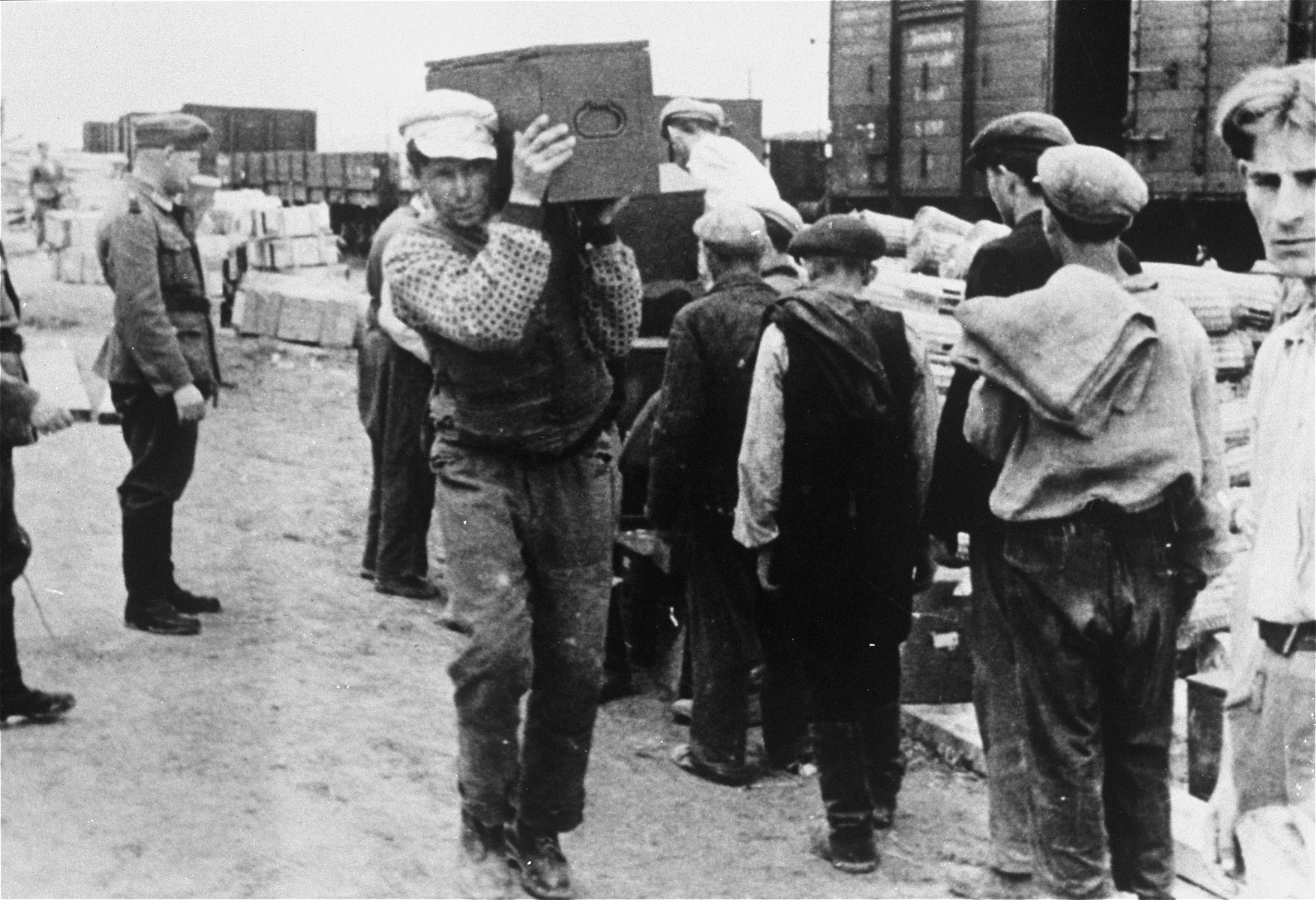
And above all, it was the arrival of the trains.
The trains came carrying people from across occupied Europe.
Many arrived believing they were being relocated.
They carried suitcases.
They carried photographs.
They carried small possessions that represented their homes and their families.
Parents held their children’s hands.
Elderly people struggled to walk after days trapped inside overcrowded cattle cars.
Young people tried to remain hopeful.
Most did not understand where they had arrived.
They did not know that within minutes, their lives would be decided.
A simple gesture from a guard.
A movement of a hand.
Left.
Or right.
Those sent one direction were selected for forced labor.
Those sent another direction were sent toward immediate death.
Rudolf Vrba saw this process repeatedly.
Again and again.
Train after train.
Day after day.
Month after month.
And he began to remember.
He did not have paper.
He did not have a notebook.
He could not safely write anything down.
So he recorded everything inside his mind.
The number of people arriving.
The dates.
The patterns.
The organization of the camp.
The way the system operated.
He became a human record of a crime that the Nazis were trying desperately to conceal.
Two Men Who Saw Different Parts of the Same Nightmare
Rudolf Vrba witnessed the beginning of the process.
Alfréd Wetzler saw what happened afterward.
Their experiences gave them two different perspectives of the same horrific machine.
Wetzler worked in areas where prisoners witnessed the aftermath of the selections.
He saw evidence of what happened after people disappeared from the railway platforms.
He understood the scale of what was taking place.
Auschwitz was not random violence.
It was not chaos.
It was organized.
It was planned.
Every part of the camp served a purpose.
The arrival platforms.
The selections.
The forced labor system.
The crematoria.
The records.
The secrecy.
Together, Vrba and Wetzler possessed something extremely rare.
They understood Auschwitz from the inside.
They knew how it worked.
They knew what the outside world needed to hear.
And by early 1944, they realized something that changed everything.
The horror was about to expand.
The Race Against Time Begins
By the beginning of 1944, Nazi Germany was under pressure.
The war was changing.
The Allied forces were advancing.
But inside Auschwitz, the machinery of destruction continued.
In fact, it was accelerating.
Vrba noticed signs that something major was coming.
Construction increased.
Rail operations expanded.
The camp was preparing for a new wave of prisoners.
Then he understood.
The next target was Hungary’s Jewish population.
Hundreds of thousands of people.
Families.
Children.
Elderly men and women.
Entire communities.
They were in danger of being sent to Auschwitz without knowing what awaited them.
For Vrba, escape was no longer only about survival.
It became a race against time.
Every day they remained trapped meant more people could be sent toward a fate they did not understand.
Most prisoners dreamed of freedom.
Vrba and Wetzler dreamed of something else:
Getting out long enough to warn the world.
They knew the odds were almost impossible.
Escape from Auschwitz was considered nearly impossible.
The camp was surrounded by electric fences.
Armed guards watched from towers.
Patrols searched constantly.
Dogs were trained to find anyone attempting to hide.
A failed escape usually meant immediate execution — not only for the person who tried, but often for others connected to them.
But they also knew something else.
Doing nothing meant accepting that thousands more would die in silence.
So they began planning.
The Three Days Beneath the Wood Pile
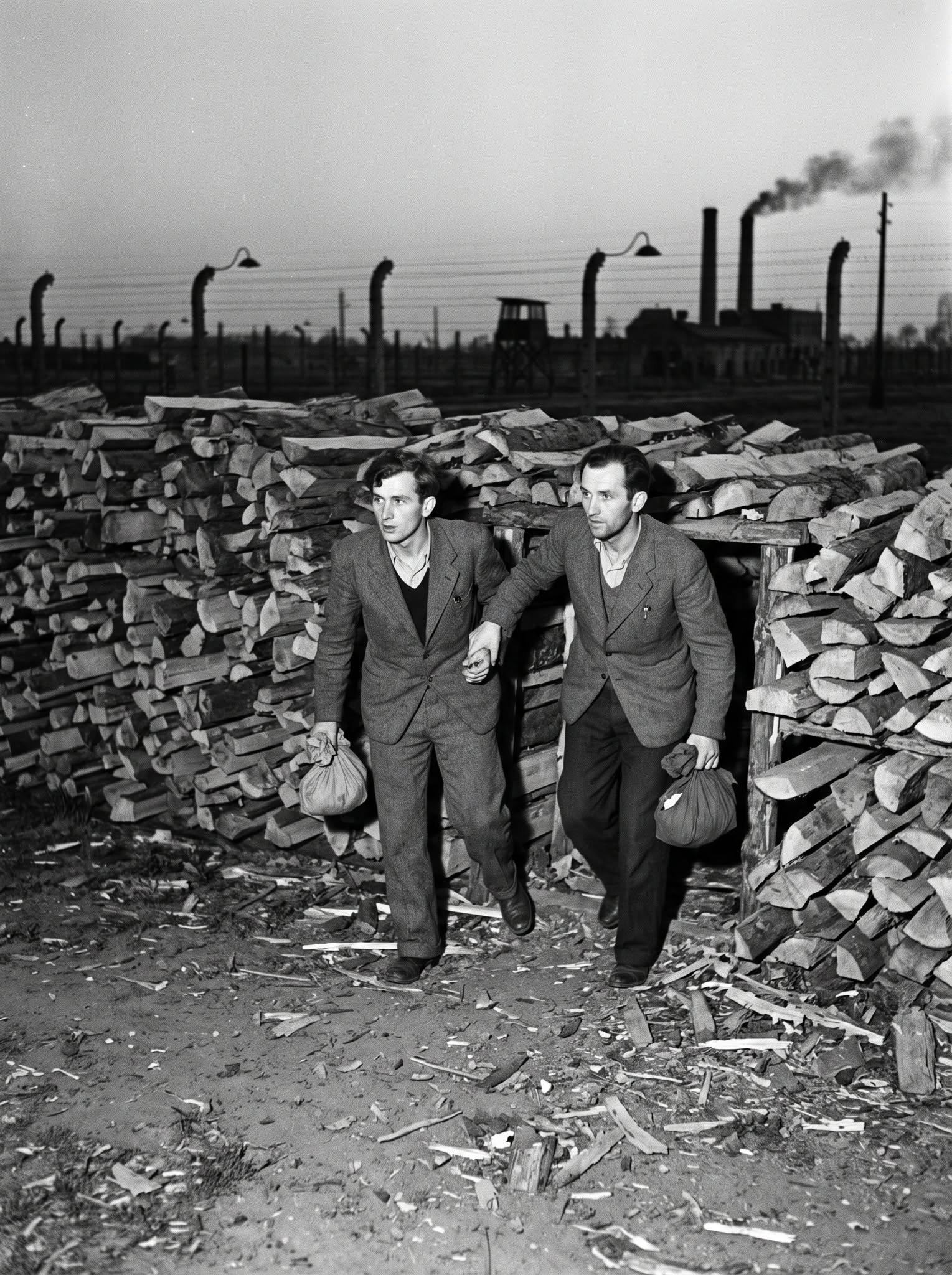
Their hiding place was small.
Almost unbelievably small.
Near the outer area of the camp, prisoners had created a hollow space inside a large pile of timber.
It was barely large enough for two people.
There was no comfort.
No room to move freely.
No guarantee they would survive even a few hours inside.
But it was their chance.
Before entering the hiding place, they prepared a desperate method to avoid detection.
Around the wood, they placed tobacco soaked with petrol.
The strong smell was intended to confuse the guard dogs that would search for them.
Then came the moment.
On April 7, 1944, Rudolf Vrba and Alfréd Wetzler disappeared.
They climbed into the hidden space.
The wood was placed back around them.
And then they waited.
For three days, they did not move.
Three days of silence.
Three days of fear.
Three days knowing that one mistake would end everything.
Above them, Auschwitz continued as normal.
Guards walked nearby.
Dogs searched.
Voices echoed through the camp.
They could hear the world outside their hiding place, but they could not see it.
They could not know whether the search was getting closer.
They could not know whether they would ever breathe fresh air again.
They had to remain completely still.
Because sometimes survival depends not on movement…
but on the ability to endure the impossible.
The Night They Crawled Out of Auschwitz
For three days, Rudolf Vrba and Alfréd Wetzler remained hidden beneath the pile of wood.
Three days without knowing what would happen next.
Three days listening to the sounds of the camp they had desperately tried to escape.
Every moment was a test.
A cough could expose them.
A movement could reveal their hiding place.
A guard deciding to search one more time could have ended everything.
But slowly, the sounds around them began to change.
The urgency faded.
The footsteps became less frequent.
The search that had consumed the camp began to disappear.
The guards believed the escapees were gone.
They had survived the most dangerous part.
Now came the next impossible challenge.
Leaving Auschwitz was only the beginning.
Freedom was still far away.
On the evening of April 10, 1944, the two men pushed aside the wood around them.
After seventy-two hours in darkness, they crawled out.
They were exhausted.
Weak.
Terrified.
But alive.
Behind them stood Auschwitz — the place where millions would suffer and die.
Ahead of them was a dangerous journey through occupied Europe.
They had no map.
No weapons.
No protection.
Only their memories, their determination, and the belief that somewhere beyond those fences, someone might listen.
They began walking.
Eighty Miles Through Darkness
The distance between Auschwitz and safety was roughly eighty miles.
But during wartime, distance was not measured only in miles.
It was measured in danger.
Every road could contain soldiers.
Every village could contain informants.
Every stranger could be either a rescuer or a threat.
Vrba and Wetzler understood that they could not travel openly.
They moved mostly at night.
When darkness covered the land, they walked.
When daylight arrived, they hid.
They slept wherever they could.
In forests.
In ditches.
In abandoned places where nobody would notice them.
They crossed unfamiliar terrain without knowing exactly what waited ahead.
Sometimes they followed stars because there was no visible path.
Sometimes they relied only on instinct.
They were two prisoners who had escaped from one of the most heavily guarded places on Earth, now trying to disappear into a continent controlled by the enemy.
The physical suffering was overwhelming.
They were hungry.
Their bodies were weakened from years of starvation.
Their clothing revealed that they were not ordinary travelers.
Anyone who saw them could understand they were running from something.
And yet, despite the danger, they continued.
Because they knew something that gave them strength:
Their journey was larger than themselves.
They were carrying a warning.